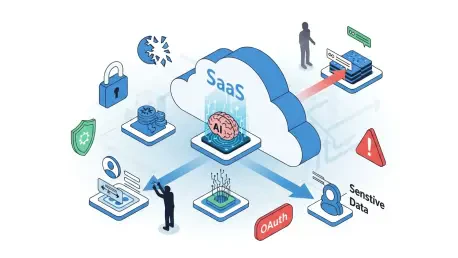

The digital architecture of the modern enterprise has undergone a radical transformation where the traditional login screen no longer serves as the primary gateway to sensitive corporate data. Instead, a silent network of interconnected applications has woven a complex web of permissions that operates largely out of sight of most security teams. As organizations increasingly rely on specialized cloud tools, the OAuth protocol has evolved into the connective tissue that allows these platforms to communicate, share information, and execute tasks autonomously. This shift has facilitated unparalleled productivity, yet it has simultaneously introduced a massive, unmanaged attack surface that traditional perimeter defenses were never designed to monitor or protect.
The Modern Interconnected Enterprise: OAuth as the Fabric of SaaS
The transition from password-based authentication to tokenized authorization represents one of the most significant shifts in enterprise technology over the last decade. By utilizing OAuth, employees can grant one application the right to access data in another without ever exposing their primary credentials. While this eliminates the risks associated with password reuse, it replaces them with a management nightmare centered on delegated authority. This framework has become the standard for seamless integration, allowing a workforce to move fluidly between platforms while maintaining a continuous flow of data across the cloud ecosystem.
However, the sheer explosion of the SaaS ecosystem has outpaced the ability of organizations to maintain effective governance over these connections. In the current landscape, a typical enterprise may have thousands of individual integrations active at any given time, ranging from simple calendar syncs to complex data analytics pipelines. This massive scale creates a environment where the visibility into who has access to what has become obscured by the sheer volume of connections. Security professionals are no longer just managing human users; they are managing an intricate map of digital relationships that define how information moves within and beyond the corporate boundary.
Artificial intelligence has acted as a significant force multiplier in this context, as AI assistants and automation tools require extensive OAuth permissions to be effective. To summarize an inbox or manage a schedule, an AI agent must possess the delegated rights to read, write, and modify data across multiple service providers. This requirement forces organizations to grant deep access to tools that function independently of active user sessions. Consequently, the traditional security perimeter has effectively dissolved, replaced by a decentralized model where persistent API access serves as the new baseline for operational efficiency.
Current Market Dynamics and the Evolution of Delegated Access
Emerging Trends in OAuth-Driven AI Integration
The rise of the AI copilot has fundamentally changed the nature of application permissions, as these agents necessitate unfettered access to the most sensitive repositories of an organization. Whether it is a coding assistant scanning a repository or a sales bot accessing a CRM, these tools depend on high-level scopes to deliver on their promises of efficiency. This trend signifies a move toward deep-tissue integration where the boundary between the user and the application is increasingly blurred. As these agents become more autonomous, the risk of a single compromised token granting access to a vast array of corporate intelligence grows exponentially.
Furthermore, the proliferation of non-human identities is reshaping how workflows are structured and secured. Service accounts and automated scripts now perform a significant portion of routine business tasks, operating 24/7 without the need for manual intervention or multi-factor authentication triggers. This shift toward a non-human workforce creates a unique challenge, as these identities do not follow the predictable patterns of behavior associated with human employees. Managing these persistent, automated entities requires a different set of tools than those used for standard identity and access management.
Industry Metrics and Growth Projections
The escalating threat landscape is reflected in recent data showing a 490% year-over-year increase in attacks specifically targeting or utilizing AI-related infrastructure. Many of these incidents leverage the inherent trust placed in OAuth tokens to bypass security controls and exfiltrate data. Industry indicators suggest that approximately 80% of modern security breaches now involve some form of sensitive data exposure through these third-party integrations. This high correlation between connectivity and vulnerability highlights a critical weakness in how modern cloud environments are currently governed and monitored.
Market projections indicate a massive shift in investment toward identity governance that can account for the complexity of the integration surface. Traditional login security is no longer sufficient when the majority of data movement occurs via back-end API calls rather than direct user interaction. As we look toward 2027 and 2028, the industry is expected to prioritize solutions that provide granular visibility into token behavior and the underlying permissions they carry. The goal is to move from a reactive posture to a model where the risk associated with every connected app is calculated and managed in real time.
Technical Obstacles and Hidden Vulnerabilities in OAuth Implementations
One of the most persistent technical challenges is the prevalence of excessive permission scopes where applications request far more access than their functionality requires. A simple project management tool might request full read and write access to a user’s entire cloud drive when it only needs to attach specific files. This over-privileging is often a result of developers seeking to avoid integration friction, but it leaves a dangerous “all-access” pass for attackers if the application is ever compromised. Narrowing these scopes is a labor-intensive process that many organizations struggle to perform at scale.
Token persistence and dormant access represent a secondary but equally dangerous vulnerability in the OAuth lifecycle. Many users authorize an application for a one-time project and then never revisit the integration, leaving an active token that remains valid for years. These “ghost” permissions create a massive back door into the enterprise, as the tokens do not expire when a project ends or when a user stops utilizing the service. This “set it and forget it” mentality has resulted in a vast archive of active connections that provide a quiet path for lateral movement within an organization’s most sensitive data stores.
Navigating the Regulatory Landscape and Compliance Standards
Regulatory bodies are beginning to take a much closer look at how delegated access impacts data privacy and security mandates. Under frameworks like GDPR and CCPA, the responsibility for data protection extends to any third-party service that processes information on behalf of the primary organization. If an OAuth-connected app mishandles data, the original data controller often bears the legal and financial brunt of the failure. This reality is forcing a reevaluation of how third-party processing is audited, as traditional point-in-time assessments are no longer adequate for continuous API-based integrations.
The evolution of AI governance frameworks is also playing a critical role in how organizations manage these risks. New standards are emerging that specifically address the retrieval and processing of data by automated agents, requiring a clear trail of authorization and purpose. Auditability remains a major gap, as many organizations find it nearly impossible to maintain a comprehensive and up-to-date inventory of all OAuth-connected applications for regulatory reporting. Without a centralized view of these connections, proving compliance with data minimization and access control requirements becomes an uphill battle.
The Future of SaaS Security: Beyond the Login Screen
The trajectory of SaaS security is moving away from the static moment of authentication and toward a model of continuous governance. In this future state, the behavior of an OAuth token is monitored just as closely as the behavior of a human user. If an integration suddenly begins downloading an unusual volume of data or accessing files it has never touched before, security systems must be able to flag or revoke that token automatically. This real-time oversight is the only way to effectively counter the speed at which automated attacks can occur in a highly connected environment.
Furthermore, the industry is seeing the emergence of centralized identity control planes designed to bridge the gap between human and non-human identity management. These platforms aim to provide a single pane of glass through which security teams can view every active connection, evaluate its risk level, and take action to mitigate exposure. Predictive risk mitigation will likely become a cornerstone of this approach, utilizing machine learning to identify which permissions are likely to be abused based on historical patterns. By proactively revoking unused or high-risk access, organizations can shrink their attack surface before a threat ever materializes.
Summary of Findings and Strategic Recommendations
The investigation into the current SaaS and AI landscape revealed that OAuth risk is no longer a peripheral concern but a core component of enterprise infrastructure expansion. Organizations that fail to account for the silent growth of delegated permissions are effectively operating with an invisible perimeter. The primary challenge identified was not the protocol itself, but the lack of centralized visibility and the tendency for permissions to drift toward over-privilege over time. To combat these trends, the focus of security operations must shift from guarding the gates to monitoring the tunnels that connect various cloud services.
Moving forward, the implementation of a continuous discovery process will be essential for identifying every active integration across the corporate environment. Regular permission audits should be established as a standard practice, focusing on the reduction of excessive scopes and the immediate revocation of tokens associated with dormant or unnecessary applications. This proactive stance ensures that the “integration surface” is kept as small as possible. Ultimately, governing the relationship between SaaS platforms and AI agents will be the defining challenge for cybersecurity professionals as they navigate the next phase of the digital era.