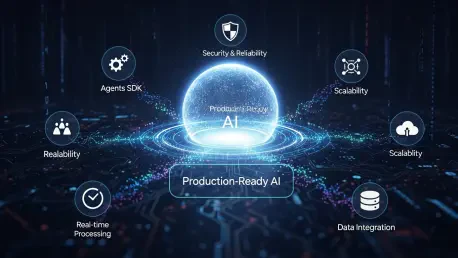

The transition from experimental artificial intelligence models to reliable autonomous systems has long been hindered by the volatile nature of code execution and the absence of standardized operational environments. On April 15, 2026, OpenAI addressed these systemic challenges by announcing a major upgrade to its Agents SDK, which introduces native sandbox execution and a sophisticated model-native harness. This development marks a shift away from brittle, custom-built execution layers toward a more unified framework where agents can perform complex tasks with unprecedented stability. By integrating these capabilities directly into the software development kit, the organization provides engineers with the tools necessary to build agents that do not just chat, but actively manipulate files, manage software dependencies, and maintain internal states across long-running workflows. This evolution is particularly significant as enterprises demand more than just generative text; they require agents that can function as reliable digital employees within secure, isolated, and scalable cloud infrastructures.
Evolution of Autonomous Execution Frameworks
One of the most impactful technical enhancements in this release is the introduction of the model-native harness, a feature designed to provide agents with a structured approach to memory and orchestration. This harness acts as a sophisticated management layer that allows an agent to maintain its internal state and tool usage effectively during long-duration operations. Previously, developers often struggled with agents losing track of their progress or failing to coordinate multiple tools during intricate sequences. By providing a sandbox-aware orchestration system, OpenAI has effectively given the AI a cognitive map of its environment, ensuring that every action taken is recorded and manageable. This architecture allows the agent to handle complex logic without the risk of recursive errors or state corruption, which has been a persistent barrier to high-stakes automation. The harness ensures that the model remains grounded in its assigned objectives while navigating the nuances of real-world data and software environments.
To complement this orchestration layer, the SDK now includes a native sandbox execution environment that provides each agent with its own dedicated and isolated workspace. Within these containers, agents are granted the authority to read and write files, install necessary software libraries, and execute code in real time—actions that were formerly restricted or required expensive, custom-built infrastructure. This isolation is critical for security and reliability, as it prevents model-generated code from interacting directly with the host system or other sensitive processes. By standardizing this execution layer, OpenAI has removed the heavy lifting of backend plumbing, allowing developers to focus entirely on the logic and goals of their agents. The sandbox environment is designed to be ephemeral and secure, ensuring that any computational side effects are contained within a controlled perimeter. This capability transforms the agent from a passive advisor into an active participant capable of solving technical problems autonomously.
Architectural Integrity and Operational Security
Security remains a primary concern for any organization deploying autonomous systems, and this update introduces a Manifest abstraction to streamline environment management across diverse platforms. This feature allows developers to define an agent’s workspace configuration in a portable format, including the mounting of local files or the integration of data from major cloud providers like Amazon Web Services S3, Google Cloud Storage, and Microsoft Azure Blob Storage. This high degree of portability ensures that a workspace defined on a developer’s laptop will function identically when deployed in a massive production cluster. By using the Manifest system, technical teams can enforce strict boundaries on what data the agent can access, thereby mitigating the risks of unauthorized data exfiltration. This structured approach to data handling ensures that the agent’s workspace is always precisely configured to the task at hand, reducing the likelihood of configuration errors that often lead to security vulnerabilities.
Beyond data management, the SDK facilitates durable execution through advanced snapshotting and rehydration techniques that protect workflows from technical failures. If a process is interrupted by a network timeout or a container expiration, the system can save the exact state of the agent and restore it instantly in a fresh environment. This resilience is vital for multi-step tasks that may take hours or even days to complete, as it prevents a minor technical glitch from causing a total loss of progress. Furthermore, the architecture supports horizontal scalability by allowing agents to spin up multiple sandboxes simultaneously to parallelize complex workloads. This means that an agent tasked with auditing thousands of financial documents can distribute the work across isolated containers, significantly increasing throughput without compromising security. This separation of the orchestration harness from the compute environment ensures that sensitive credentials and configurations are never exposed to the model-generated code.
Industry Adoption and Future Technical Pathways
The practical utility of these enhancements is already being demonstrated in highly regulated sectors where precision and security are non-negotiable requirements. For instance, Oscar Health has utilized the updated SDK to automate clinical record workflows that were previously considered too complex for standard artificial intelligence applications. By leveraging the improved understanding of encounter boundaries and medical data structures, the system successfully navigated dense clinical documentation with a level of accuracy that matches human oversight. This success illustrates how the SDK’s new features enable agents to handle specialized, data-heavy tasks that require both deep context and the ability to execute specific analytical tools. As more companies integrate these tools into their core operations, the focus is shifting from simple automation to the creation of robust, self-healing digital ecosystems that can operate independently within complex enterprise environments.
Despite the significant progress represented by this release, certain limitations remain that define the current development roadmap for the technology. The new features are presently exclusive to the Python programming language, leaving developers who rely on TypeScript or other environments waiting for future updates. Additionally, more advanced features like a dedicated code mode are still in the testing phases and have not yet reached full production status. However, the SDK’s integration with various sandbox providers, including Cloudflare, E2B, and Vercel, indicates a strong commitment to an open and modular ecosystem. As the industry moves toward more autonomous systems, this release established a framework for agents that were not only more capable but also significantly more reliable in enterprise settings. Developers were encouraged to begin migrating existing prototypes to the new Manifest-based architecture to take advantage of the enhanced security and durability features. Moving forward, the focus shifted toward expanding language support and refining the orchestration of multi-agent systems.