
Boardrooms asked for agility and got a maze of systems and teams: composable ERP promised speed, yet complexity multiplied faster than oversight, leaving leaders balancing rapid change, rising risk, and stubborn operating costs. The shift from monoliths to modular stacks created undeniable flexibility, but it also scattered data, exposed brittle integrations, and turned vendor release cadences into a constant source of uncertainty. The result felt less like a platform and more like an estate—dynamic, sprawling, and difficult to govern at scale.
Market Overview and Current State
Enterprises rebuilt ERP around core suites stitched to best-of-breed SaaS and cloud platforms, betting that specialization would outpace one-size-fits-all. That bet paid off in function-specific capability but exacted a toll on operations: frequent updates, shifting APIs, and hidden cross-app dependencies outstripped manual monitoring. The integration fabric became the new control plane, yet most organizations treated it as plumbing rather than as a strategic asset.
However, the pattern is now clear. Agility lives or dies on lifecycle discipline. Teams that rely on tickets, periodic audits, and after-the-fact triage keep discovering breakage late, when users and revenue feel it. In contrast, orgs that anchor operations in continuous detection, automated validation, and role-aware enablement compress release cycles and reduce defect escape, not by adding tools, but by unifying them around a closed feedback loop.
Drivers, Signals, and Near-Term Outlook
Three forces reshaped the ERP landscape. SaaS proliferation expanded choice and velocity but introduced relentless change. Shift-left operations moved quality gates earlier, making prevention a core design goal. Embedded AI stepped out of pilot mode to guide tests, explain anomalies, and surface non-obvious dependencies. Together, these shifts signaled a transition from system ownership to lifecycle stewardship.
Market signals pointed the same way. Spend migrated from bespoke integration work to platforms that fuse data, APIs, and events into shared telemetry. Adoption curves favored suites that expose open APIs and event streams, because they feed impact analysis and observability. Performance benchmarks improved where organizations tied release velocity to risk controls, measuring defect escape rate, MTTR, and adoption health as a single operating scorecard rather than siloed KPIs.
Operating Gaps and Lifecycle Remedy
Fragility emerged from root causes that looked mundane in isolation: disconnected apps, brittle integrations, and fragmented data. When multiplied across dozens of vendors and hundreds of workflows, those small cracks formed systemic risk. The answer was not a return to monoliths; it was lifecycle optimization—treating every change as part of a governed flow from detection to validation to enablement to monitoring.
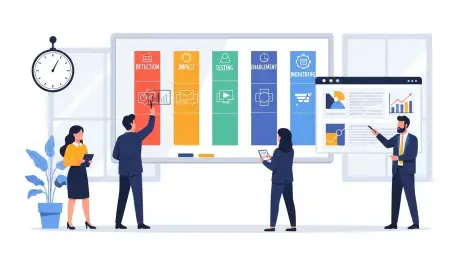
Lifecycle optimization hinged on five coordinated capabilities. Automated change detection established ground truth by flagging configuration shifts, metadata edits, and API changes as they happened. AI-driven impact analysis mapped dependencies to anticipate ripple effects. Agentic test automation targeted exactly what changed, validating processes and integrations at scale. Dynamic user enablement delivered in-flow, role-aware guidance the moment new behavior landed. AI-enabled observability closed the loop with proactive monitoring, root-cause insights, and preventative actions tied to business outcomes.
Implementation Patterns and Governance
Execution mattered as much as tooling. High performers instrumented the ERP estate with telemetry first, normalizing events from suites, integration layers, and niche apps into a shared backbone. From there, they built knowledge graphs that connected data objects, workflows, identities, and controls, enabling explainable impact analysis and precise test selection.
Governance evolved in parallel. Release councils shifted from calendar-based approvals to evidence-based gates powered by automated proofs: what changed, where risk concentrated, what was tested, which roles needed training, and how observability would watch the rollout. Vendors remained part of the equation through SLAs and shared responsibility models, but internal orchestration determined whether constant updates became safe momentum or recurring disruption.
Compliance and Secure Operations
Regulatory pressure did not slow change; it reshaped how change was managed. Data privacy and residency requirements demanded clear lineage across systems, while SOX and ISO/IEC 27001 elevated continuous, machine-generated audit evidence over manual attestations. Security-by-design meant identity-first controls, least privilege, and robust segregation of duties across a composable stack where access and workflow intersected daily.
Moreover, compliant change required traceability. Each release needed a narrative: detected deltas, assessed impacts, executed tests, targeted enablement, and active monitors. That single thread satisfied auditors, aligned stakeholders, and reduced the risk of silent drift—turning compliance from a drag on delivery into a catalyst for disciplined execution.
Strategic Outlook and Next Steps
The path forward favored convergence over tool sprawl. Platforms that unify integration, testing, training, and observability reduced handoffs and eliminated blind spots, while agentic AI in production handled change triage, test selection, and guided remediation with human-in-the-loop guardrails. Operating metrics that mattered—release velocity, defect escape rate, MTTR, and adoption health—became board-level signals tied to value realization and risk hedging.
This report concluded that composability worked only when governed as a living lifecycle. Recommended next steps focused on phasing adoption: assess current sprawl and critical dependencies; instrument end to end with telemetry; automate change detection and impact analysis; scale agentic test factories; deploy in-product guidance; and enforce continuous verification through AI-enabled observability. Taken together, these moves turned firefighting into orchestration, transformed compliance into evidence-driven confidence, and converted ERP from a maze into a strategic engine for change.