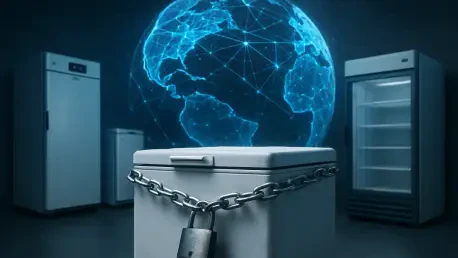

Cybersecurity experts are tracking a dangerous trend where threat actors transition from stealing digital data to sabotaging physical refrigeration infrastructure in healthcare facilities. This shift represents a fundamental change in the threat landscape, where the primary objective is no longer the exfiltration of sensitive patient records but the disruption of life-sustaining environments. In the years from 2026 to 2028, the focus on securing Operational Technology is expected to intensify as global supply chains become more reliant on internet-connected sensors and automated climate controls. The intersection of physical logistics and digital connectivity has created a new class of vulnerabilities that traditional security measures are often ill-equipped to address. As healthcare providers and food distributors integrate more smart technology to improve efficiency, they inadvertently expand the attack surface for sophisticated adversaries who understand the high stakes of a compromised cold chain. This evolution necessitates a proactive re-evaluation of digital safety protocols to prevent tangible, real-world damage that could jeopardize public health on a massive scale.
The Escalation: Industrial Cyber Threats
Real-World Consequences: Impact of European Infrastructure Breaches
The reality of these threats became undeniable in late 2024, when a series of coordinated cyberattacks paralyzed hundreds of supermarkets across France before spreading to Germany and Finland. These intrusions targeted the electronic controllers responsible for regulating temperatures in industrial-grade refrigeration units, allowing hackers to manipulate settings remotely. Consequently, retailers were forced to discard massive quantities of spoiled food, resulting in catastrophic financial losses and significant friction within regional supply chains. This wave of disruption proved that cybercriminals are increasingly moving beyond financial extortion to target the physical stability of essential services. By focusing on the hardware that sustains the cold chain, threat actors demonstrated an ability to cause widespread economic damage and social unrest without ever setting foot in a physical facility. These events served as a stark warning to international regulators that the digital systems managing our food supply are now frontline targets in a new era of industrial warfare.
Case Study: Physical Risks to Healthcare Systems
The threat reached a critical peak when the French Health Ministry reported that cold rooms in regional blood banks had been breached by external actors. While medical staff successfully relocated the blood supplies before they were ruined by temperature fluctuations, the incident highlighted the immediate life-safety risks inherent in vulnerable Operational Technology systems. These controllers, which are often left connected to the public internet for the convenience of remote monitoring and routine maintenance, have become primary entry points for attackers seeking to inflict maximum societal impact. Unlike traditional Information Technology breaches that compromise data privacy, these attacks directly threaten the physical integrity of biological materials and life-saving medications. The blood bank incident underscored the reality that a single digital vulnerability can lead to a medical emergency if not detected and mitigated within a very narrow window of time. This realization has prompted a global shift in how medical facilities view their cooling infrastructure, moving from a purely mechanical concern to a high-priority cybersecurity requirement.
Regional Responses: Defensive Strategies
Strategic Governance: National Security Priorities
While some regions have yet to experience these specific attacks, agencies like the Cyber Security Agency of Singapore have adopted a proactive stance to prevent local complacency. By coordinating closely with food agencies and major retailers, the government is emphasizing that organizations must secure their remote access protocols long before a localized crisis occurs. This preemptive strategy is particularly vital for nations that rely heavily on imports and constant refrigeration, where even a short period of cooling downtime can lead to a national food security issue. The Singaporean approach involves a rigorous assessment of how internet-facing assets are documented and protected within the national infrastructure. Authorities are currently working to ensure that as the logistics sector modernizes, the adoption of efficient, internet-connected technology does not inadvertently create backdoors for cybercriminals. By treating the cold chain as a pillar of national security, regulators are setting a new standard for how governments must oversee the digital health of the physical systems that provide essential resources to their citizens.
Air-Gapping: Traditional Safeguards in a Digital Era
A significant defense currently utilized by some major retailers involves the practice of air-gapping, where refrigeration systems are kept entirely disconnected from the public internet. This traditional approach provides a natural and robust barrier against remote hacking, as there is no digital path for an external attacker to exploit. However, as the industry moves toward 2028, the pressure to integrate smart technology and real-time data analytics grows, often tempting organizations to bridge these gaps for the sake of operational efficiency. Leaders in the sector are finding that maintaining a balance between technological advancement and physical security is increasingly difficult. While air-gapping remains an effective shield, it often prevents the use of predictive maintenance tools that could identify mechanical failures before they happen. Consequently, the challenge for modern logistics firms is to implement security-by-design principles that allow for the benefits of connectivity without sacrificing the inherent safety of an isolated system. This tension defines the current strategic landscape for cold-chain operators who must protect their assets against a growing array of digital threats.
Technical Failures: Weaknesses in Operational Technology
Critical Vulnerabilities: Controller Hardware and Firmware
The primary reason why industrial systems remain soft targets is that they were originally designed for mechanical reliability and longevity rather than digital resilience. Unlike traditional IT environments that undergo frequent security hardening, many industrial controllers lack basic firewalls and continue to operate using factory-set default passwords that are easily bypassed by automated scanning tools. These devices are often deployed with the expectation that they will function for decades, long outlasting the security protocols that were relevant at the time of their installation. Furthermore, the firmware powering these controllers is frequently outdated and may no longer receive security patches from the original manufacturers. When a vulnerability is discovered, the specialized nature of the equipment means that any downtime required for a software update is viewed as a threat to productivity. This culture of prioritizing operational uptime over digital hygiene creates a significant window of opportunity for sophisticated threat actors to exploit known holes in the system, turning reliable hardware into a liability that can be manipulated from across the globe.
Supply Chain Risks: Maintenance and Third-Party Backdoors
Technical weaknesses are often exacerbated by the complex web of third-party contractors responsible for maintaining industrial refrigeration units. Many businesses outsource the monitoring and repair of their cooling systems to external vendors who use remote access tools to provide 24/7 support. If a contractor’s own network is compromised, it can provide a direct backdoor into the critical systems of dozens of different clients simultaneously. This supply chain vulnerability means that even an organization with perfect internal security can be brought down by a lapse at a partner company. Attackers are aware of these interdependencies and frequently target smaller maintenance firms as a way to gain access to larger, more lucrative targets in the healthcare and retail sectors. To combat this, organizations are beginning to demand higher security standards from their vendors, including the use of multi-factor authentication and encrypted communication channels. However, the sheer number of connected devices and the variety of vendors involved make it difficult to maintain a consistent defensive perimeter, leaving many cold chains exposed to risks that originate far beyond their own digital borders.
Future Resilience: Mitigation and Strategic Defense
Geographic Factors: Time-Critical Responses in Tropical Climates
The physical impact of a cooling system failure is often dictated by local environmental conditions, which significantly change the risk profile for different regions. In tropical climates, the window for corrective action after a cooling failure is much narrower than in cooler regions, making the risk of a total loss almost instantaneous if a system is sabotaged. While a supermarket in a temperate zone might have several hours to save its inventory, a similar facility in a high-temperature environment may see its goods spoil in a fraction of that time. This geographic reality forces organizations in warmer regions to adopt more aggressive monitoring and faster response protocols. Beyond the food and medical sectors, these vulnerabilities extend to automated logistics warehouses and centralized building controls for elevators and HVAC systems. In these contexts, a digital intrusion does more than just damage inventory; it can endanger human life or cause extensive mechanical damage to the building’s core infrastructure. Understanding these sector-specific risks is essential for developing a comprehensive defense strategy that accounts for the physical environment in which the digital systems operate.
Implementation: Robust Defense Frameworks and Information Sharing
To mitigate the growing threat of industrial sabotage, experts emphasized the need for a cohesive framework focused on comprehensive inventory management and network segmentation. Organizations were urged to identify every single internet-connected device on their network and isolate legacy hardware on restricted subnets that do not have direct paths to the public web. This strategy prevents an attacker who gains access to a low-security device from moving laterally through the network to reach critical refrigeration controllers. Additionally, fostering cross-sector information sharing became a cornerstone of modern industrial defense, ensuring that a vulnerability discovered in the retail sector could be patched in hospitals and warehouses before it was exploited. By treating cybersecurity as a collaborative effort rather than a private concern, industries were able to build a collective resilience that made it much harder for threat actors to succeed. Implementing these multi-layered defenses required a significant shift in corporate culture, but the results demonstrated that a proactive and well-coordinated approach was the only way to protect the essential services that modern society depends upon daily.
Path Forward: Strengthening Industrial Resilience
The analysis of global industrial security trends demonstrated that the era of treating refrigeration as a purely mechanical concern has officially ended. Organizations that successfully navigated these challenges did so by integrating cybersecurity directly into their operational workflows, ensuring that every new piece of hardware was vetted for digital vulnerabilities before installation. It was determined that the most effective leaders prioritized network segmentation and the elimination of default credentials, effectively closing the easiest entry points for automated attacks. Furthermore, the collaboration between government agencies and private sector operators established a new baseline for national safety, where the integrity of the cold chain was recognized as a vital component of public health. These efforts proved that while the threat of physical sabotage is real and growing, it is not insurmountable for those who are willing to invest in modern defensive strategies. Ultimately, the industry moved toward a model of security by design, where resilience was built into the foundation of the system rather than added as an afterthought. This transition allowed for the continued expansion of global logistics while significantly reducing the risk of a catastrophic digital disruption to the physical world.