
The software-as-a-service industry has generated trillions in value by promising streamlined efficiency, yet it has simultaneously shackled modern businesses to a model of staggering complexity and hidden operational costs. For two decades, enterprises have adopted SaaS as the engine of digital transformation, relying on its power to scale operations and innovate. This reliance, however, has created a deep-seated dependency on a paradigm that is becoming increasingly unsustainable. The very tools meant to empower workers are now often the source of their greatest friction, demanding specialized expertise and constant maintenance just to function. As a new technological wave emerges, the fundamental flaws in the traditional SaaS model are not just being exposed; they are being rendered obsolete.
The SaaS Paradox: An Industry We Cant Live With and Cant Live Without
The ascent of the software-as-a-service model represents one of the most significant business shifts of the 21st century. Industry titans like Salesforce, Workday, and ServiceNow have become indispensable, forming the operational backbone for companies across every sector. They have democratized access to powerful enterprise-grade software, replacing cumbersome on-premise installations with flexible, scalable cloud solutions. This revolution promised to lower barriers to entry and accelerate growth, and for a long time, it delivered on that promise, creating an ecosystem that businesses now find impossible to operate without.
However, beneath this veneer of success lies the central paradox of modern SaaS: its user experience is fundamentally broken. The initial promise of intuitive, self-service software has given way to a reality defined by overwhelming complexity. Instead of empowering employees to achieve outcomes directly, these platforms present a labyrinth of settings, workflow builders, and Byzantine interfaces. This has created an environment where the software itself becomes a full-time job, not a tool to get a job done. The value is there, but it is locked behind layers of friction that require significant investment to overcome.
The current state has normalized a dependency on human intermediaries to bridge the gap between user intent and software action. To extract the advertised value from a major SaaS platform, organizations must hire dedicated administrators, engage expensive implementation consultants, and often require their staff to obtain professional certifications. Business logic is not simply executed; it must be painstakingly translated into the rigid language of the software through endless configuration and custom development. This model transforms a tool meant to increase efficiency into a major operational burden, a system that serves its own needs as much as the user’s.
The Escalating Crisis of Complexity and Cost
The New Normal: Tool Sprawl and AI Fragmentation
The complexity crisis is compounded by the unchecked proliferation of applications within the enterprise. The average business now juggles an ever-expanding portfolio of SaaS tools, each designed to solve a specific problem. This “tool sprawl” creates significant operational friction as data becomes trapped in isolated silos, preventing a unified view of the customer or business processes. Integrating these disparate systems becomes a monumental task, leading to brittle connections and inconsistent workflows that hinder productivity rather than enhance it.
Into this already fragmented landscape, the first wave of artificial intelligence has arrived not as a solution but as an accelerant to the problem. Nearly every SaaS vendor is rushing to embed a proprietary “copilot” or AI agent into its platform. While powerful in isolation, these agents are not designed to communicate with one another. A company managing over a hundred distinct applications is now faced with the prospect of also managing a hundred siloed, non-communicative AI assistants. This AI fragmentation doubles the configuration burden and fails to address the core issue of cross-platform integration, creating localized intelligence at the expense of holistic business insight.
Beyond the Subscription: The Hidden Taxes Draining Your Business
The advertised subscription fee for a SaaS product represents only a fraction of its true cost of ownership. Businesses are burdened by a series of hidden surcharges, or “taxes,” that quietly drain resources. The most visible is the “Ops Tax,” the significant investment in specialized human capital—administrators, developers, and operations teams—required to configure, integrate, and maintain the software. The cost of this human layer often eclipses the cost of the software license itself, turning a modest subscription into a major financial commitment.
Beyond direct financial costs, these hidden taxes erode productivity and create strategic risk. The “Time Tax” manifests in the daily friction employees experience navigating complex interfaces, costing thousands of hours in lost productivity. The “Knowledge Tax” represents the liability of embedding critical business logic into arcane system configurations understood by only a few specialists; when those employees leave, they take the institutional knowledge with them. Finally, the “Opportunity Tax” is the most damaging of all—the cost of focusing finite resources on maintaining existing systems instead of pursuing innovation and strategic growth. These accumulating costs are pushing the current SaaS model toward an unsustainable breaking point.
The Core Flaw: When Building Blocks Get in the Way of Building
The primary obstacle preventing SaaS from fulfilling its promise is the profound disconnect between what users want and what the software provides. Businesses purchase software to achieve specific outcomes, such as automating a sales process, resolving a customer ticket, or launching a marketing campaign. What they receive, however, is not a direct path to these outcomes but rather a complicated toolkit of building blocks. They are given workflow builders, settings menus, and intricate graphical user interfaces (GUIs), and the burden is placed squarely on them to assemble these components into a functional solution.
This paradigm forces users to become de facto system architects and developers. A marketing manager who simply wants to send a follow-up email sequence must first learn to navigate a complex workflow automation tool, wrestling with triggers, delays, and conditional logic. A sales leader seeking to adjust a lead scoring model is confronted with a wall of settings and dependencies. Instead of focusing on their core responsibilities and strategic goals, employees are forced to spend their time deciphering the rigid logic of the software, translating their intent into a series of clicks and configurations.
Ultimately, this approach creates a cycle of dependency on technical specialists for even the most basic operational tasks. Business users are unable to make simple changes or launch new initiatives without filing a ticket and waiting for an over-burdened operations team. This not only creates a significant bottleneck but also stifles agility and experimentation. The software, which was meant to be an enabler, becomes a gatekeeper, placing a technical barrier between the business and its ability to execute on its own strategy.
The Compliance Blind Spot: How Complexity Creates Unseen Risks
The practice of embedding critical business logic into intricate and often poorly documented software configurations introduces significant and frequently overlooked risks. Complex automated workflows that dictate how customer data is handled, how financial transactions are processed, or how access controls are enforced become “black boxes” over time. This lack of transparency makes it exceedingly difficult to audit processes, ensure regulatory compliance with standards like GDPR or CCPA, and adapt to new legal requirements, creating a hidden compliance liability.
This risk is amplified by the “Knowledge Tax,” where the departure of a key operations employee can result in a catastrophic loss of institutional control. When the only person who understands a critical system’s architecture leaves, the company is left with a functional but incomprehensible asset. This creates a major data governance and security vulnerability, as no one may fully understand who has access to what data or how that data is being used. The operational stability of the business becomes dangerously tied to the tenure of a few individuals.
The emerging landscape of fragmented AI agents only exacerbates these challenges. Each new copilot introduces its own set of permissions, its own knowledge base, and its own access protocols. Managing security and compliance across dozens or even hundreds of siloed AI systems becomes an exponentially more complex task. Ensuring that each agent adheres to company-wide data governance policies and regulatory mandates is a monumental challenge, opening up new vectors for data leakage, unauthorized access, and compliance failures.
The Great Unbundling AI as the New Operating Layer
The solution to the crisis of SaaS complexity lies not in building better graphical interfaces, but in making them disappear altogether. The next evolution of business software will be defined by the unbundling of the user interface from the underlying application logic. The traditional GUI, with its menus, dashboards, and settings screens, is becoming a legacy artifact. In its place, a new, conversational interface is emerging as the primary way users will interact with their entire technology stack.
This future state is built on an intent-driven model. Instead of clicking through a dozen screens to build a workflow, a user will simply state their goal in natural language: “Alert the account owner on Slack when a key customer’s support ticket has been open for more than 48 hours.” The AI layer will interpret this intent and translate it into the necessary actions across multiple systems—in this case, the CRM and the communications platform—without the user ever needing to open either application. The conversation becomes the configuration.
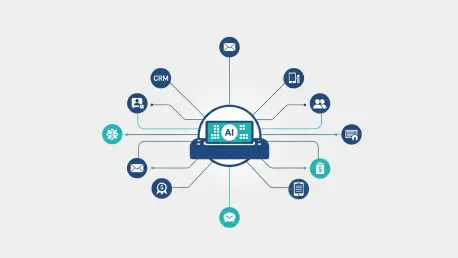
In this new paradigm, AI will evolve from a feature embedded within an application to a universal operating layer that sits on top of all applications. This horizontal AI platform will serve as the central nervous system for the enterprise, capable of orchestrating complex, cross-functional processes based on human language commands. The underlying SaaS applications will be relegated to the role of “headless” databases and execution engines, their complex interfaces made redundant by a more intuitive and powerful conversational layer.
A New Ecosystem: The Winners Losers and What Comes Next
The transition from a tool-centric to an outcome-centric model signaled a profound realignment of the SaaS ecosystem. This shift did not merely introduce new features; it dismantled the very foundation upon which the previous generation of software was built, creating a new set of winners and losers. The victors were those who embraced the conversational paradigm, while incumbents who clung to their complex GUIs found themselves at a significant disadvantage.
The most successful players in this new era were the horizontal AI platforms that became the primary operating layer for the enterprise, alongside a new breed of AI-native startups built from the ground up with a conversation-first architecture. These companies understood that the value was no longer in the feature list of a single application but in the ability to seamlessly orchestrate outcomes across the entire software stack. In contrast, legacy SaaS vendors who merely bolted AI “copilots” onto their existing interfaces struggled to compete, as their approach was seen as a temporary patch on a fundamentally broken model.
This analysis concluded that preparing for this shift required a change in mindset for all stakeholders. Business leaders and operations professionals were advised to begin thinking strategically about the outcomes they wanted to achieve, freed from the technical constraints of their current tools. Founders were urged to design products as if the GUI did not exist, focusing instead on intent and action. Ultimately, the future of enterprise software was defined not by more complex tools, but by an intelligent, conversational layer that finally allowed technology to adapt to human intent, not the other way around.