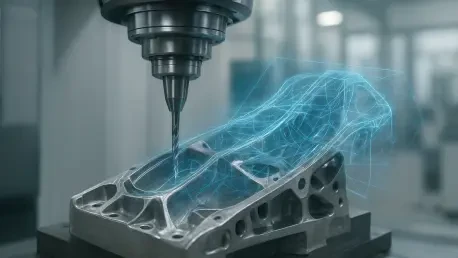

A resurgence in domestic manufacturing and a robust defense sector are propelling the United States toward a 21.1 percent growth rate in the adoption of virtual machining technologies. This shift represents a fundamental departure from the traditional, iterative “cut-and-check” methods that have defined machine shop operations for decades. As of 2025, the market for Computer Numerical Control (CNC) digital twin software reached a notable valuation of over $635 million, marking a transition point where high-fidelity virtual modeling has become a prerequisite for industrial competitiveness. These digital twins provide an exact, dynamic replica of physical machines, controllers, and workpieces, allowing for a seamless flow of data between the virtual and physical realms. By synchronizing machine behavior with micro-level precision, engineers are now able to visualize the entire machining process before a single chip is carved from a raw block of material. This capability is not merely about visualization; it is about creating a mathematical certainty that the physical execution will mirror the virtual intent, thereby eliminating the risk of costly errors.
The current landscape of manufacturing intelligence is characterized by this move toward a digital-first approach, where the virtual environment serves as the primary laboratory for innovation. Unlike basic CAD/CAM simulations that might only offer a general visualization of toolpaths, modern CNC digital twin software accounts for the complex physics of the machine tool itself, including its specific kinematics and controller logic. This level of detail allows manufacturers to anticipate how a machine will react to specific commands under various load conditions, providing a level of foresight that was previously unattainable. The primary objective driving this adoption is the total elimination of machine collisions, which can result in hundreds of thousands of dollars in repairs and lost production time. Furthermore, in an era where material costs for advanced alloys are skyrocketing, the ability to minimize waste through perfect first-part production has become a critical factor in maintaining healthy margins in a highly competitive global market.
Financial Projections: Assessing a Decade of Industrial Expansion
The financial outlook for the CNC digital twin software sector indicates an aggressive expansion phase that will redefine the industrial software market over the next ten years. Starting from a projected base of $760 million in 2026, the market is on a trajectory to exceed a valuation of $4.5 billion by 2036. This growth represents a consistent compound annual growth rate of nearly 20 percent, a figure that highlights the urgent demand for intelligent automation across all major manufacturing hubs. This decade-long surge is expected to generate a massive revenue opportunity of approximately $3.79 billion, reflecting a profound structural shift in how companies allocate their capital expenditures. The transition is being fueled by a combination of factors, including the rapid industrialization of emerging economies and a significant pivot toward advanced software-as-a-service (SaaS) models in established markets.
This projected revenue growth is not distributed evenly across all sectors, but rather concentrated in areas where the complexity of production justifies the investment in high-end simulation. Manufacturers are increasingly recognizing that the cost of software is a fraction of the potential losses incurred by machine downtime or scrapped precision parts. The rise of subscription-based models has played a pivotal role in this financial evolution, as it allows for a more flexible and predictable expenditure pattern for small and medium-sized enterprises. By lowering the initial barrier to entry, these models have enabled a broader range of shops to access the same sophisticated tools used by global conglomerates. This democratization of technology is expected to maintain market momentum, ensuring that the demand for digital twin capabilities remains robust even as broader economic conditions fluctuate.
Deployment Strategies: The Rise of Cloud and Subscription Models
By the end of 2026, cloud-based and subscription-oriented deployment models are expected to capture more than half of the total market share for CNC digital twin software. This transition reflects a major change in the manufacturing mindset, as engineering teams move away from isolated, on-premise installations toward more collaborative and accessible platforms. Historically, many manufacturers were hesitant to store sensitive engineering data in the cloud due to security concerns; however, the emergence of highly secure, industrial-grade cloud environments has largely mitigated these fears. The benefits of this shift are numerous, including the ability to access centralized tool libraries, receive real-time software updates, and reduce the heavy hardware requirements typically associated with high-performance simulation. This move toward the cloud facilitates a more integrated workflow where design and manufacturing data can be shared across different geographic locations instantly.
The shift toward these flexible models has also catalyzed the widespread adoption of machining simulation as the primary use case for digital twin technology. In current operations, checking toolpaths and verifying machine movements within a virtual environment is the most effective way to ensure operational safety. The software meticulously scans for potential collisions between the cutting tool, the spindle, and the machine’s internal fixtures, providing a safety net that protects both the hardware and the operator. For most companies, this verification process serves as the entry point into the digital twin ecosystem, proving its value through immediate risk reduction. As these tools become more integrated into the standard workflow, they are evolving from simple error-checkers into proactive optimization platforms that can suggest more efficient cutting strategies based on the specific capabilities of the physical machine.
Operational Capabilities: Virtual Commissioning and Predictive Maintenance
A rapidly expanding segment of the market is focused on virtual commissioning, a process that allows manufacturers to test entire production lines in a virtual space before physical construction begins. This capability is becoming essential for companies that need to bring new products to market with extreme speed and precision. By simulating the interaction between multiple machines, robotics, and conveyor systems, engineers can identify bottlenecks and logic errors early in the planning phase. This foresight significantly reduces the time required for on-site setup and troubleshooting, which often accounts for a major portion of project delays. Virtual commissioning essentially creates a “digital rehearsal” for the factory floor, ensuring that when the physical components are finally assembled, the system operates at peak efficiency from the very first day.
Beyond the initial setup, advanced CNC digital twin software is increasingly being used for predictive maintenance and real-time process optimization. Modern platforms are capable of simulating the wear and tear on machine components based on the intensity of the simulated workloads. By analyzing these virtual data points, software can predict when a spindle might require servicing or when a specific tool is likely to fail, allowing maintenance teams to intervene before an actual breakdown occurs. Additionally, these tools can now recommend optimized cutting speeds and feed rates that maximize material removal while minimizing stress on the machine tool. This proactive approach to machine health and efficiency is transforming the role of the digital twin from a static model into a dynamic asset that actively contributes to the longevity and profitability of the manufacturing facility.
Industry Applications: High Stakes in Aerospace and Multi-Axis Milling
The aerospace industry remains a dominant force in the adoption of digital twin technologies, driven by the extreme cost of raw materials and the rigorous safety standards required for flight components. When working with expensive metals such as titanium or specialized superalloys, a single programming error can result in a scrapped part worth tens of thousands of dollars. Aerospace manufacturers utilize digital twins to verify that the very first component produced meets all design specifications, a concept often referred to as “first-time-right” manufacturing. This precision is vital because the complex geometries of engine components and structural frames leave no room for error. The high stakes involved in these projects make the investment in sophisticated simulation software an easy decision for leadership teams focused on risk management.
Similarly, the complexity of multi-axis milling centers has created a significant demand for digital twin simulation. As machines move across five or more axes simultaneously, the risk of a collision or a near-miss increases exponentially. Modern manufacturing trends favor completing a part in a single setup to maintain tight tolerances and reduce handling time, but this requires intricate machine movements that are difficult to visualize without advanced software. The digital twin provides a necessary safety net for these complex operations, allowing programmers to see exactly how the machine will behave at every degree of rotation. By simulating these movements, shops can push their machines to their physical limits with the confidence that the toolpaths have been thoroughly vetted in a virtual environment, thereby maximizing the return on investment for their high-end machinery.
Geographic Growth: National Strategies for Digital Transformation
South Korea is currently leading the global market in terms of growth rate, a position supported by aggressive government initiatives focused on smart manufacturing. These national programs provide significant financial and technical assistance to small and medium-sized businesses, encouraging them to digitize their production floors and adopt virtual machining tools. For South Korea, maintaining a competitive edge in high-tech electronics and automotive manufacturing requires a workforce that is proficient in digital twin technologies. The government’s focus on creating “smart factories” has made virtual machining a top national priority, resulting in a rapid surge of software adoption across the peninsula. This top-down approach has created a robust ecosystem where software developers and manufacturers work closely together to refine simulation capabilities.
In the United States and the United Kingdom, the growth of the digital twin market is closely linked to a renewed focus on domestic production and national security. In the UK, programs like “Made Smarter” are designed to help smaller manufacturers remain competitive by providing them with the tools needed for digitalization. In the United States, the strong defense sector remains the primary engine for advanced simulation adoption, as contractors look for ways to increase the efficiency of complex defense projects. The push for “onshoring” manufacturing has also created a need for high levels of automation to offset higher labor costs. By utilizing digital twins, American and British manufacturers are able to maintain high productivity levels with smaller, more specialized workforces, ensuring that domestic production remains economically viable in the long term.
European Perspectives: Integration in Automotive and Machinery Sectors
Industrial powerhouses like Germany and France are leveraging digital twin software to maintain their leadership in the automotive and heavy machinery sectors. In Germany, the integration of digital twins into world-class automotive production lines has become a standard practice for optimizing throughput and reducing energy consumption. German manufacturers are particularly focused on using these tools to support the transition to electric vehicle production, which requires the rapid reconfiguration of existing machining centers. Meanwhile, France’s market growth is heavily influenced by its massive aerospace sector, where companies are using virtual machining to develop the next generation of fuel-efficient aircraft engines. These European nations view the digital twin as a vital component of their long-term industrial strategy, ensuring that their manufacturing bases remain resilient in the face of global competition.
Japan continues to be a vital player in this market, both as a consumer of digital twin software and as the home to many of the world’s leading machine-tool builders. Japanese manufacturers have a long-standing reputation for precision and reliability, and the adoption of virtual machining is seen as a natural extension of their commitment to quality. Japanese machine builders are increasingly integrating digital twin capabilities directly into their hardware offerings, providing customers with a pre-configured virtual model of their new machine. This integration helps users get up and running faster and ensures that the simulation is perfectly aligned with the physical machine’s specifications. The collaborative relationship between software providers and machine builders in Japan is a key factor in the continued evolution of the market, driving the development of more accurate and user-friendly simulation tools.
Technical Foundations: G-Code Verification and the Skills Gap
One of the most critical technical drivers for the adoption of digital twin software is the necessity for exact G-code verification. G-code is the specialized language that tells a CNC machine exactly where and how to move, and any discrepancy between the intended path and the machine’s interpretation can be catastrophic. Modern digital twin software is designed to read the exact G-code that will be sent to the physical machine, ensuring that the simulation is a perfect reflection of reality rather than just a rough approximation. This level of verification is what provides manufacturers with the certainty they need to run expensive, high-speed operations without constant human supervision. It acts as a final filter that catches errors in the post-processing stage, where the design data is converted into machine instructions.
In addition to technical verification, digital twins are playing a crucial role in addressing the growing skills gap within the manufacturing industry. As a generation of highly experienced machinists reaches retirement age, companies are struggling to find new technicians with the same level of tribal knowledge. Virtual environments allow newer operators to experiment with different setups and machining strategies without the risk of damaging expensive equipment. It serves as a powerful training platform where mistakes are encouraged as a learning tool, rather than feared as a financial disaster. By lowering the stakes of the learning process, digital twins are helping to accelerate the onboarding of new workers and ensuring that the next generation of manufacturing professionals is equipped with the digital skills required for the modern factory floor.
Implementation Hurdles: Modeling Legacy Systems and Data Security
Despite the clear benefits, several challenges remain that prevent some manufacturers from fully embracing digital twin technology. One of the most significant hurdles is the difficulty of creating accurate virtual models for older, legacy machines that were built before digital twins were a standard consideration. If a virtual model does not perfectly match the physical dimensions and controller logic of the aging machine, the simulation loses its predictive value. Many shops operate a mix of new and old hardware, making it difficult to implement a uniform digital twin strategy across the entire floor. Additionally, the process of manually modeling these older machines can be time-consuming and expensive, requiring specialized knowledge that many smaller shops lack.
Data security also remains a prominent concern, particularly for manufacturers operating in sensitive industries like medical device production or defense contracting. The move toward cloud-based digital twins requires companies to transmit highly detailed engineering data over external networks, which some organizations view as an unacceptable risk. Protecting intellectual property from cyber threats is a top priority, and the perceived vulnerability of the cloud keeps some firms tethered to less efficient, on-premise solutions. Furthermore, the sheer volume of data generated by high-fidelity simulations can strain existing IT infrastructures, requiring significant investments in bandwidth and storage capacity. Overcoming these hurdles will require continued advancements in encryption technology and a more standardized approach to machine modeling across the industry.
Market Leadership: Integrated Solutions and Industry Standards
The competitive landscape of the CNC digital twin market is currently dominated by large, integrated players like Siemens and Hexagon, who offer a comprehensive suite of hardware and software solutions. Siemens, in particular, has a unique advantage because it manufactures both the simulation software and the physical controllers that run the machines. This allows for a “closed-loop” system where the virtual and physical environments are perfectly synchronized, providing a level of accuracy that is difficult for independent software vendors to match. Hexagon has similarly built a massive portfolio of tools through strategic acquisitions, focusing on creating an end-to-end digital thread that connects design, manufacturing, and metrology. These leaders are setting the standard for how digital twin technology should be integrated into the broader manufacturing ecosystem.
While the giants lead the way, specialized players like Dassault Systèmes and CGTECH continue to provide essential tools that have become industry standards for verification. CGTECH’s VERICUT software, for instance, remains a preferred choice for many manufacturers because of its ability to provide independent verification across a wide variety of machine brands and controller types. This independence is highly valued by shops that operate diverse fleets of machinery and do not want to be locked into a single manufacturer’s ecosystem. Meanwhile, Autodesk has made significant strides in making these tools more accessible to a wider audience. By integrating simulation and digital twin capabilities into cloud-native platforms like Fusion, they have significantly lowered the technical and financial barriers for smaller machine shops, helping to drive the overall expansion of the market into new sectors.
Strategic Outlook: AI Integration and Economic Interconnectivity
Manufacturers recognized the undeniable link between the production of durable goods and the adoption of digital twin software as a means of survival. They observed that as global demand for consumer electronics and industrial machinery fluctuated, the companies that maintained the highest levels of efficiency were those that had invested heavily in virtualized workflows. Decision-makers identified that increasing productivity did not always require purchasing more physical hardware; instead, it often meant getting more out of existing assets through better simulation and planning. The realization that digital twins could reduce machine idle time and minimize the need for physical prototypes transformed the technology from a luxury into a strategic necessity for any shop aiming for long-term resilience.
In the final stages of this technological evolution, the partnership between software developers and high-performance computing firms became the primary engine for innovation. Stakeholders looked toward the integration of artificial intelligence to manage the vast amounts of data generated by digital twins. They found that AI-powered twins could run thousands of “what-if” scenarios in seconds, identifying the perfect balance between cutting speed, tool life, and energy consumption. This shift toward autonomous optimization meant that the digital twin was no longer just a mirror of reality, but a proactive guide for the manufacturing process. Industry leaders ultimately concluded that those who integrated these advanced capabilities were best positioned to navigate the complexities of the modern industrial economy, leaving behind the era of trial and error once and for all.