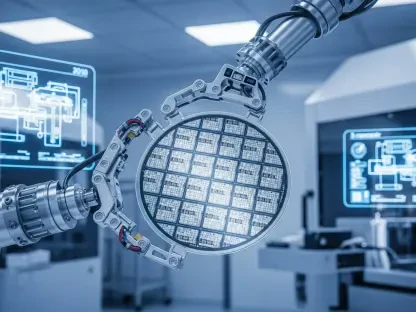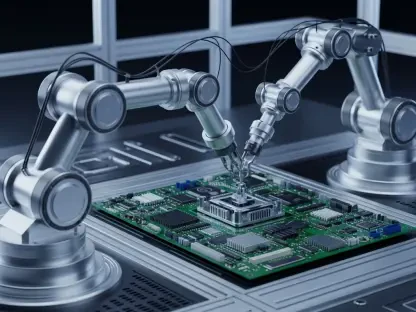

The breathtaking speed at which high-performance computing now evolves has created a profound tension between the engineers architecting a digital future and the financiers tasked with pricing its immediate value. Nvidia’s recent GTC conference served as a bold manifesto for the future of computing, yet the immediate reaction from the financial sector was surprisingly lukewarm. While the unveiling of a roadmap teeming with next-generation Blackwell chips and autonomous systems signaled a leap forward, the market’s dip highlighted a growing rift between technological acceleration and investor confidence.
Understanding this friction is essential because it illustrates the challenge of a company projecting a multi-trillion-dollar AI future while a market remains haunted by the specter of overvaluation. Financial analysts often struggle to reconcile unprecedented growth with unproven long-term returns on investment. This analysis examines the clash between Nvidia’s expansion and the “wait-and-see” posture adopted by global capital, which remains cautious despite the sheer scale of the technological shift currently underway.
The Great Disconnect: Why Silicon Valley’s Vision and Market Skepticism Are at Odds
The recent presentations from Silicon Valley suggest an industrial revolution is happening in real time, but Wall Street often views these developments through a lens of risk management. While engineers see the Blackwell architecture as the foundation for the next decade of progress, investors see high capital expenditure with uncertain horizons. This disconnect stems from different timelines: technology moves in months, while institutional portfolios often require years of stable performance to justify such aggressive valuations.
Moreover, the skepticism is fueled by the memory of previous tech cycles where enthusiasm outpaced the actual utility of the products. Even as revenue figures soar, some market participants worry that the current demand is a front-loaded surge rather than a permanent plateau. This creates a volatile environment where even record-breaking news can result in a stock cooldown as the market pauses to digest the implications of such rapid change.
Navigating the Friction Between Record Innovation and Investor Hesitation
The Innovation Paradox: High-Performance Blackwell Chips and the Market’s Counterintuitive Reaction
The unveiling of the Blackwell architecture and the Vera Rubin system represents a leap in processing power that would usually trigger an immediate market rally. However, the tepid response to these breakthroughs suggests that technical superiority is no longer enough to satisfy cautious observers. A phenomenon known as the “great new uncertainty” has emerged, where the very speed of hardware cycles creates anxiety about whether the global economy can integrate these tools fast enough to justify their high costs.
Analyzing the 73% year-over-year revenue surge against the immediate post-keynote cooling reveals a clear challenge to the assumption that better specs lead to higher valuations. Investors are no longer just looking for faster chips; they are looking for evidence that the companies buying these chips can turn them into profitable services. This shift in focus indicates that the hardware phase of the AI boom is maturing, and the market is now demanding proof of software-driven returns.
Betting on Trillions: Forecasting the Massive Scale of AI Agents and Physical Robotics
Nvidia has positioned itself at the epicenter of two massive new markets: a $35 trillion sector for AI agents and a $50 trillion industry for physical AI and robotics. These figures are supported by massive infrastructure commitments, such as the pledge by cloud giants to integrate one million GPUs into their services. Furthermore, projections of $1 trillion in chip orders by 2027 suggest that the momentum is far from slowing down.
This perspective shifts the focus from Nvidia as a mere component supplier to a foundational architect of the next industrial era. Experts examine whether these projections are grounded in the tangible needs of the modern workforce or if they represent a level of optimism that exceeds the speed of enterprise adoption. While the numbers are staggering, they reflect a belief that AI will soon manage everything from logistics to complex decision-making processes in every global industry.
From Silicon to Systems: How Nvidia Is Rewiring Global Industry as a Primary Platform
Moving beyond the data center, the concept of Physical AI is beginning to define the future of heavy industry. By partnering with industrial giants like Caterpillar, Nvidia is demonstrating that its technology is essential for the next generation of autonomous machinery and manufacturing. This evolution transforms the company into a utility-like platform provider, where the global economy begins to orbit around its specific hardware and software stack.
While some critics argue that enterprise adoption remains slow, a deeper look at industry shifts suggests that the inflection point for AI scaling is already here. The integration of advanced processing into manufacturing lines and supply chains represents a shift toward permanent infrastructure. Even if the financial receipts remain obscured by traditional accounting metrics, the fundamental way that goods are produced and moved is being rewired toward an automated, AI-driven model.
The Bubble Debate: Distinguishing Short-Term Market Volatility from Fundamental Economic Shifts
The fear of an “AI bubble” remains a primary headwind for market performance as investors weigh the current lack of defined ROI against explosive growth. However, comparing the current landscape to past technological bubbles reveals significant differences, particularly regarding Nvidia’s role as a primary platform provider. Unlike speculative service companies of the past, the current leaders are providing the physical infrastructure that makes the entire ecosystem possible.
This challenges the assumption that market nervousness reflects a flaw in strategy, suggesting instead that volatility is a byproduct of the market’s inability to process the long-term implications of AI inevitability. When infrastructure becomes as essential as the power grid, its value is rarely captured by short-term trading patterns. The transition from speculative asset to essential utility is often marked by exactly the kind of friction and skepticism seen in today’s financial headlines.
Managing the AI Transition: Strategic Considerations for Investors and Enterprises
To navigate current volatility, stakeholders must look past the 2.5-hour keynote cycles and focus on the long-term integration of AI into core business processes. Investors should prioritize understanding the “Physical AI” roadmap, as the real value of the ecosystem lies in its ability to automate heavy industry and logistics. This approach requires a move away from short-term stock watching and toward a strategy that accounts for the decades-long deployment of autonomous systems.
For enterprises, the best practice involves moving beyond experimentation and toward scalable infrastructure that utilizes the current Blackwell cycle to gain a competitive edge. These strategies emphasize a shift from temporary pilot programs to the construction of foundational intelligence layers within the organization. By focusing on the long-term participation in what is becoming the 21st-century economy, businesses ensured they were not left behind as the baseline for industrial productivity shifted.
The Inevitability Factor: Why Nvidia’s Roadmap May Outpace Immediate Market Fears
The fundamental demand for AI infrastructure remained decoupled from the stock market’s immediate nervousness as the global economy moved toward total digitalization. Nvidia’s strategy treated the integration of high-level intelligence into every sector as a historical certainty rather than a speculative bet. As the company continued to shatter revenue estimates and secure massive purchase orders from cloud giants, the gap between investor fear and industrial reality narrowed.
Ultimately, the role of a central pillar in the modern economy suggested that while the pace of change was uncomfortable for the market, the technological shift was both profound and permanent. New insights into the scalability of autonomous systems showed that the transition was less about a single “bubble” and more about the birth of a new industrial standard. Stakeholders who recognized this early moved to secure their place in a world where computing power replaced traditional energy as the primary driver of global wealth and productivity.