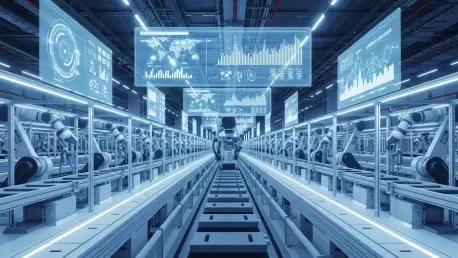

The convergence of high-performance computing and enterprise management is no longer a distant ambition but a lived reality that is currently redefining the boundaries of global manufacturing. As production lines become increasingly complex, the traditional separation between the machines on the shop floor and the software in the executive suite is rapidly dissolving. This shift is driven by the urgent need for a unified operational architecture where data flows seamlessly from a robotic arm to a financial report without manual intervention.
Bridging this gap requires a sophisticated blend of physical AI and digital infrastructure. By synchronizing shop-floor operations with executive decision-making, companies can move toward a model where every mechanical action is reflected in the enterprise resource planning system. This evolution is particularly visible in the Asia-Pacific region, which remains the heart of global production and serves as a testing ground for specialized industrial environments that outperform general-purpose AI applications in terms of efficiency and ROI.
Analyzing the Shift Toward AI-Driven Industrial Ecosystems
The Rise of the AI Factory and Physical Intelligence
Modern manufacturing is transitioning from a collection of standalone digital tools to fully integrated, autonomous factory environments. This transformation is fueled by the integration of Foxconn’s massive computing hardware with SAP’s sophisticated supply chain tools, creating a feedback loop that optimizes production in real time. Rather than reacting to delays, these AI-native systems anticipate bottlenecks before they occur, allowing the factory to function as a self-correcting organism.
Corporate behaviors are evolving to keep pace with these technological leaps. Organizations are moving beyond basic digital transformation to adopt operational models where AI is the core architect of production schedules and logistics. The Foxconn-SAP partnership acts as a critical catalyst in this transition, providing the framework for repeatable industrial use cases that can be deployed across various sectors, from electronics to automotive assembly.
Evaluating Growth Projections for Industrial AI in the APAC Region
The surge in smart manufacturing investments across Asia highlights a significant market shift. Current data suggests that AI-driven supply chain solutions will experience exponential growth from 2026 through 2030, as manufacturers seek to mitigate global volatility. This trend is forcing traditional hardware giants to reinvent themselves as integrated software and infrastructure providers, fundamentally changing their value proposition to investors and clients alike.
Regional market drivers, such as high manufacturing complexity and the demand for logistical resilience, are accelerating this adoption. As labor costs rise and production requirements become more stringent, the ability to deploy intelligent automation becomes a competitive necessity. Asia’s role as a global hub ensures that the innovations developed here will eventually set the standard for industrial operations worldwide.
Overcoming the Complexities of Large-Scale AI Integration
Technical hurdles remain a significant barrier to the seamless link between legacy factory-floor systems and modern cloud-based software. Integrating decades-old machinery with cutting-edge AI requires robust middleware and a strategy for breaking down persistent data silos. Without a cohesive flow between production data and administrative oversight, the true potential of the AI factory remains locked behind incompatible protocols and fragmented databases.
Furthermore, the talent gap presents a human challenge to technological progress. Upskilling the workforce to operate within an AI-augmented framework is essential for long-term success. Scalability also poses a problem, as a model that works in a single facility must be adapted to function across diverse global production sites with varying regulations and infrastructure quality.
Navigating the Regulatory Landscape of Global Industrial Data
Data sovereignty laws and cross-border transfer regulations are becoming increasingly central to global supply chain strategies. As industrial AI relies on massive datasets, ensuring compliance with local privacy and security standards is paramount. Establishing rigorous security protocols for physical AI is not just about safety; it is about protecting intellectual property and manufacturing secrets from sophisticated cyber threats.
Compliance requirements for AI-driven automation are also evolving to include specific industrial safety protocols. International standards will play a decisive role in shaping the interoperability of these platforms, allowing different systems to communicate securely. Organizations that lead the way in setting these standards will likely dominate the market by providing the most reliable and compliant solutions.
Forecasting the Long-Term Evolution of Smart Manufacturing
In the coming years, AI will transition from an operational elective to an absolute necessity for market survival. Emerging disruptors, such as generative AI for product design and predictive maintenance at scale, will further compress development cycles. We are moving toward a future defined by hyper-localized, resilient supply chains that use real-time data to pivot instantly in response to economic shifts or sustainability requirements.
The push for greener manufacturing will also accelerate AI adoption. Intelligent systems can optimize energy consumption and reduce waste in ways that human managers simply cannot. As global economic conditions remain unpredictable, the efficiency gains provided by integrated AI will become the primary buffer against market instability and resource scarcity.
Defining the New Standard for Industrial Competitiveness
The partnership between Foxconn and SAP demonstrated that linking enterprise intelligence with physical production capacity is the only viable path forward for large-scale industry. By creating a blueprint for global industrial transformation, this alliance signaled the end of isolated manufacturing processes. Stakeholders who prioritized the integration of hardware and software were positioned to capture the highest value in an increasingly automated world.
The industry moved toward a standard where operational control was synonymous with data mastery. Successful adopters invested heavily in modular AI architectures that allowed for rapid scaling and localized adaptation. Ultimately, the integration of physical and digital intelligence proved to be the decisive factor in establishing a new benchmark for global industrial resilience and competitive advantage.