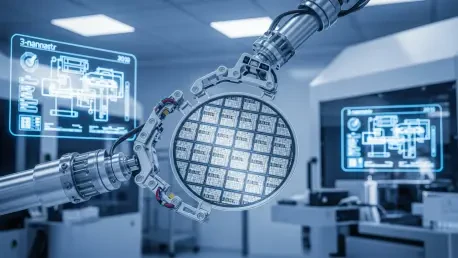

The global thirst for specialized silicon has reached a fever pitch, transforming the quiet corridors of semiconductor labs into the most consequential battlegrounds of the modern economy. While the initial wave of the generative AI boom was defined by a frantic scramble for any available processing power, the current landscape reflects a more calculated and architectural shift. Amazon Web Services, long the quiet backbone of the internet, has stepped out from the shadow of third-party hardware providers to assert itself as a primary architect of the silicon that runs the world’s most sophisticated models. This strategic evolution represents more than just a cost-saving measure; it is a fundamental realignment of the cloud computing power structure. By moving toward a vertically integrated model, Amazon is attempting to decouple its future from the supply chains of legacy chipmakers, promising a new era of efficiency for an industry that has grown weary of the premium prices and long wait times associated with traditional GPU monopolies.
Scaling the Silicon Frontier: Amazon’s High-Stakes Move
The journey toward self-reliance in the semiconductor space did not happen overnight, but rather through a decade of calculated acquisitions and internal cultural shifts. The pivotal moment occurred when the company integrated the specialized expertise of Annapurna Labs, an Israeli firm that brought a “scrappy” engineering ethos to the cloud giant’s massive operations. This partnership allowed for the creation of a proprietary hardware stack that spans from the Nitro virtualization system to the latest iterations of the Trainium series. Unlike traditional chip manufacturers that must design general-purpose products for a wide variety of customers, Amazon’s engineers design for their own data centers. This specificity allows them to strip away unnecessary overhead, focusing entirely on the performance metrics that matter most to cloud-based AI workloads.
This transition from a hardware renter to a hardware maker has fundamentally altered the competitive dynamics of the cloud sector. In the past, cloud providers were largely indistinguishable in their hardware offerings, with everyone bidding for the same limited pool of external processors. Today, the ability to offer custom-tuned silicon like Trainium3 has become a primary differentiator. This shift matters because it provides a roadmap for how large-scale enterprises can bypass the traditional bottlenecks of the semiconductor industry. By owning the design process, Amazon ensures that its infrastructure is perfectly synchronized with the software layers it hosts, creating a cohesive ecosystem that is increasingly difficult for competitors to replicate without similar multi-billion-dollar investments in research and development.
The Evolution of AWS Silicon: From Annapurna to Trainium
To understand where the market is heading, one must recognize that the “silicon bring-up” process—the high-stakes moment when a new chip is powered on for the first time—is now the heartbeat of Amazon’s innovation cycle. The labs in Austin, Texas, operate with an intensity that mirrors a startup rather than a corporate behemoth, with engineers often working around the clock to bridge the gap between theoretical physics and physical reality. This culture of rapid prototyping has enabled the company to move through three generations of Trainium silicon with remarkable speed. Each iteration has moved closer to the bleeding edge of fabrication, with the latest 3-nanometer designs representing the absolute pinnacle of what is currently possible in mass-market semiconductor manufacturing.
Furthermore, the strategic importance of this vertical integration extends beyond the chips themselves to the very racks and cooling systems that house them. As processors become more dense and powerful, traditional air cooling has reached its physical limits. Amazon’s response has been to design entire “UltraServer” sleds that incorporate advanced liquid cooling and high-speed networking switches directly into the architecture. This holistic approach ensures that the performance gains seen on paper actually translate to real-world data center environments. By controlling everything from the microscopic transistors to the massive industrial cooling units, the company has created a resilient supply chain that is insulated from the fluctuations of the broader hardware market, providing a level of stability that is highly attractive to enterprise clients.
Breaking the Monopoly: Technical Innovation and Market Strategy
The Shift from Model Training to Real-World Inference
In the current market cycle, the focus of the AI industry has undergone a significant transformation, moving from the resource-heavy phase of training models to the high-volume phase of inference. While training a model like Claude or GPT-4 requires massive bursts of power, running those models for millions of users every second—known as inference—is where the long-term economic sustainability of AI will be decided. Amazon’s Trainium3 is specifically optimized for this phase, providing the high-throughput, low-latency performance required to power live AI agents and real-time translation services. By targeting inference, AWS is addressing the most scalable segment of the AI economy, ensuring that as AI becomes a utility, the underlying hardware is cost-effective enough to support mass adoption.
Neutralizing Software Lock-in Through Open-Source Integration
Historically, the biggest barrier to entry for any new chipmaker was not the hardware itself, but the software ecosystem that surrounded it. Nvidia’s dominance was protected by a massive library of proprietary code that made switching to a different architecture a nightmare for developers. Amazon has strategically dismantled this barrier by embracing open-source frameworks, particularly PyTorch. By investing heavily in the “Neuron” software development kit, Amazon has made the migration process nearly invisible. Engineers can now port their models to Trainium with minimal code changes, effectively turning a once-prohibitive technical hurdle into a simple recompilation task. This move democratizes access to high-performance hardware and forces the market to compete on price and efficiency rather than architectural inertia.
Architectural Excellence and the Power of Custom Networking
The technical prowess of the Trainium3 architecture is best exemplified by its unique networking capabilities. Traditional data center setups often suffer from “congestion” when thousands of chips try to communicate at once, leading to performance drops. Amazon solved this by developing custom “Neuron” switches that allow for a mesh configuration, where every chip in a cluster can communicate with any other chip with almost zero latency. This level of interconnectivity is essential for the next generation of “frontier” models, which are too large to fit on a single chip and must be distributed across massive server clusters. Combined with the Nitro system, which offloads background tasks to dedicated hardware, this architecture ensures that nearly 100% of the chip’s power is dedicated to actual AI computation, maximizing the return on every watt of electricity consumed.
The Road Ahead: Trends and Future Transformations
The trajectory of the AI infrastructure market points toward an era of extreme specialization. The days of the one-size-fits-all processor are fading, replaced by a landscape where the most successful companies are those that can tailor their hardware to the specific needs of the algorithms they run. We are seeing a move toward even more advanced fabrication processes, with 2-nanometer technology already on the horizon, promising even greater energy efficiency. As energy costs become the primary constraint on AI scaling, the integration of on-site renewable energy and proprietary liquid cooling systems will become standard for any serious cloud provider. The economic pressure to reduce the “cost per token” will drive more companies to follow Amazon’s lead, either by designing their own chips or by partnering with providers who offer specialized silicon.
Moreover, the role of “anchor tenants”—massive AI labs like Anthropic and OpenAI—will continue to shape the development of custom silicon. These organizations provide the guaranteed demand that justifies the astronomical research and development costs of new chip designs. As these labs move toward building “AI agents” capable of autonomous reasoning, the hardware requirements will shift again, likely toward chips that can handle complex branching logic as efficiently as they handle linear algebra. Amazon’s $50 billion investment into the infrastructure for these players suggests a future where the cloud provider is no longer just a landlord, but a co-developer of the intelligence itself, with the hardware and the software evolving in a tight, recursive loop of innovation.
Navigating the Shift: Strategic Takeaways for the AI Era
For organizations looking to maintain a competitive edge, the primary lesson is that hardware flexibility is now a strategic necessity. Relying on a single hardware provider introduces significant supply chain risks and subjects a company to the pricing whims of a monopoly. Decision-makers should prioritize the adoption of hardware-agnostic software frameworks to ensure they can pivot to the most cost-effective silicon as it becomes available. The claimed 50% cost savings of specialized UltraServers are too significant to ignore, especially for companies whose core business models are increasingly dependent on high-volume AI inference. Diversification of compute resources is no longer just an IT decision; it is a fundamental part of risk management in the digital age.
Furthermore, technical leaders must look beyond the raw teraflops of a processor and evaluate the total cost of ownership, including power efficiency and ease of integration. The transition to specialized chips like Trainium requires an initial investment in testing and optimization, but the long-term operational benefits are substantial. As the market matures, the competitive advantage will go to those who can execute their AI strategies at the lowest possible cost, allowing them to offer faster, more reliable services to their end users. Utilizing specialized silicon for live applications is the most direct path to achieving this operational efficiency, providing a sustainable foundation for growth in an increasingly crowded and expensive AI marketplace.
Conclusion: A New Foundation for Digital Intelligence
The development and deployment of custom silicon at Amazon Web Services marked a definitive turning point in the history of cloud computing and artificial intelligence. By successfully navigating the transition from the Trainium2 to the cutting-edge Trainium3, the company proved that a cloud service provider could effectively challenge the established leaders of the semiconductor industry. The technical innovations housed within the Austin lab—ranging from liquid-cooled server sleds to the mesh-networking capabilities of Neuron switches—created a highly integrated infrastructure that offered a compelling alternative to traditional GPUs. This shift was characterized by a move away from general-purpose hardware toward specialized, inference-optimized systems that prioritized price-to-performance over legacy brand loyalty.
The broader implications of this evolution were felt across the entire tech ecosystem as major AI laboratories began to migrate their most significant workloads to these custom architectures. Amazon’s ability to lower the barriers to entry through open-source software compatibility ensured that the transition was not only technically feasible but also economically unavoidable for those operating at scale. As the scarcity of high-end processors eased, the market entered a more mature phase where efficiency and vertical integration became the primary drivers of success. The work performed in the silicon labs ultimately laid the groundwork for a more accessible and affordable era of digital intelligence, ensuring that the infrastructure of the future remained as dynamic as the models it supported. Accomplishing this required a relentless focus on the intersection of hardware and software, a strategy that redefined the boundaries of what a cloud provider could achieve.