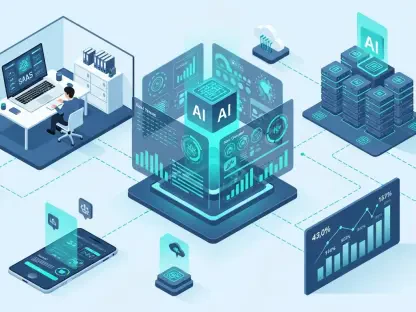

Digital identities have become the primary currency of the modern dark web, leading to a landscape where stolen credentials can dismantle entire corporate infrastructures in a matter of seconds. As organizations increasingly migrate their operations to the SaaS ecosystem, the traditional perimeter has effectively vanished. This transition has exposed a glaring vulnerability: the reliance on passwords and multi-factor authentication alone is no longer a sufficient defense against sophisticated adversaries who have mastered the art of session hijacking.
Zero Trust architecture has emerged as the definitive standard for modern cybersecurity, moving away from the assumption that any user inside a network is inherently safe. This model operates on the principle of explicit verification, where trust is never granted by default and must be continuously earned. By shifting toward a multi-layered verification model, enterprises are now focusing on identity-centric and device-centric controls to mitigate the inherent risks of cloud-native technologies.
The Critical Shift Toward Identity and Device-Centric Cloud Security
The rapid expansion of the software-as-a-service environment has rendered traditional firewalls and perimeter-based defenses nearly obsolete. Attackers frequently exploit the gap between user identity and the physical machine being used to access sensitive data. Without a mechanism to verify the integrity of the hardware, a valid set of credentials becomes a skeleton key that grants unauthorized access to a company’s most sensitive cloud assets.
Implementing a multi-layered verification model ensures that a login attempt is only successful when several independent factors align. Beyond just knowing a password, the system checks for specific hardware signatures and managed connection pathways. This shift in enterprise risk management acknowledges that the device is just as important as the person sitting behind the keyboard, creating a more resilient barrier against credential-based exploits.
Emerging Paradigms in Cloud Access and Security Performance
Innovative Trends Reshaping the Zero Trust Landscape
Device-level validation is gaining significant traction as a primary countermeasure to the growing problem of MFA fatigue and sophisticated phishing campaigns. When security protocols require a specific, pre-approved machine to complete a handshake with the cloud resource, the threat of an external actor using stolen tokens is virtually eliminated. This evolution transforms security from a single check at login to a continuous verification process that monitors the session throughout its duration.
Moreover, the integration of managed brokers is becoming a standard practice for organizations that want to hide their cloud resources from the public internet. By utilizing a secure gateway, businesses can ensure that their applications never face direct exposure. This allows for a seamless user experience that remains impenetrable to outsiders, satisfying the dual demand for high productivity and uncompromising data protection across distributed workforces.
Market Growth and the Data-Driven Future of Secure Access
Recent statistical trends indicate a sharp rise in credential-based breaches, forcing a massive reallocation of IT budgets toward more robust access technologies. The Zero Trust Network Access market is projected to see exponential growth through 2030 as companies abandon legacy virtual private networks in favor of more granular controls. These device-centric models are not just about safety; they significantly reduce the mean time to detect threats by flagging unauthorized hardware immediately.
Industry forecasts suggest a rapid adoption of unified security consoles that provide a single pane of glass for managing both endpoint protection and cloud access. This centralization allows administrators to correlate data from various sources, leading to a more proactive security posture. As performance indicators continue to show that multi-dimensional verification prevents lateral movement, the shift toward consolidated security platforms is expected to accelerate.
Navigating the Sophisticated Hurdles of Modern Cyber Threats
Standard multi-factor authentication is proving to be an insufficient shield against advanced techniques like credential stuffing and session hijacking. Once a session token is intercepted, an attacker can bypass traditional security measures entirely, masquerading as a legitimate user. This reality necessitates a more rigorous approach where the connection is tied to a specific hardware profile that cannot be easily replicated or stolen by remote actors.
Managing a diverse ecosystem of endpoints in a world dominated by personal devices poses another significant challenge for modern enterprises. Organizations must find a way to enforce strict security protocols without hindering the productivity of employees who rely on flexible work arrangements. By focusing on verifiable hardware and secure broker paths, companies can prevent lateral movement within multi-tenant environments, ensuring that one compromised account does not lead to a total system failure.
Regulatory Standards and the Compliance Mandate
Zero Trust cloud access is no longer just a technical preference; it is a fundamental requirement for meeting international regulatory standards like GDPR, HIPAA, and SOC2. These frameworks demand high levels of data integrity and granular audit trails that track every access request. Managed connection pathways provide the necessary documentation to prove that only authorized personnel using approved hardware have interacted with sensitive data.
The influence of federal security benchmarks has also pushed the private sector toward more stringent standards. Organizations are increasingly focused on data sovereignty and privacy, ensuring that information stays within specific geographical or logical boundaries. By enforcing strict access rules and maintaining detailed logs, businesses can navigate the complex landscape of global compliance while protecting their intellectual property from external and internal threats.
The Horizon of Cloud Security and Future Innovations
The integration of artificial intelligence is set to revolutionize real-time anomaly detection, allowing systems to identify suspicious access patterns before a breach occurs. Future-proofing these environments also requires a look at the looming threat of quantum computing, which may eventually challenge current encryption standards. As security matures, the concept of identity-first protection will evolve into context-aware autonomous protection that adjusts permissions based on environmental factors.
Anticipating the convergence of network security and endpoint protection into single-vendor platforms will likely define the next generation of IT infrastructure. This consolidation reduces complexity and eliminates the gaps that often exist between disparate security tools. By moving toward a model where the network and the device communicate in a unified language, organizations can achieve a level of visibility and control that was previously impossible.
Building a Resilient Future Through Verifiable Trust
The synthesis of valid credentials, authorized hardware, and secure brokers has established a new benchmark for organizational resilience. This approach effectively neutralized the risks associated with modern identity-based attacks by ensuring that no single point of failure can grant access to the cloud. The transition from legacy systems was validated by the substantial reduction in unauthorized access attempts and the streamlining of audit processes for compliance teams.
Looking forward, organizations should prioritize the decommissioning of aging VPNs and the adoption of continuous verification frameworks to stay ahead of evolving threats. The focus must remain on creating a transparent yet rigid environment where every connection is scrutinized and every device is known. This long-term strategy ensured that security was not just a reactive measure, but a foundational element of the business architecture that supported both growth and innovation.