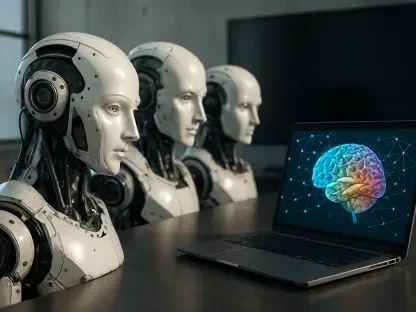

The bright lights and buzzing halls of the Consumer Electronics Show often present a fractured vision of the future, but a powerful narrative emerged from the noise this year, coalescing around three forces vying to redefine our world. Artificial intelligence, electric mobility, and the pervasive collection of big data are no longer siloed industries but intertwined elements of a single, overarching technological revolution. From the factory floor to the family living room, these pillars of innovation are not just competing for investment and attention; they are actively shaping one another, creating a complex ecosystem where progress in one domain accelerates change in the others. The event provided a definitive snapshot of this new reality, forcing industries to confront a landscape where smart devices are data conduits, vehicles are intelligent agents, and AI is the universal language of progress.
The Undeniable Ascent of Artificial Intelligence
The New Industrial and Automotive Revolution
The abstract concept of artificial intelligence is now being forged into the very steel of heavy industry, promising a new era of efficiency and safety. Caterpillar, a titan of industrial machinery, revealed a groundbreaking collaboration with Nvidia to create “Cat AI,” an advanced assistive pilot designed to transform its massive equipment into intelligent “robotic companions” for human operators. This is not merely a software overlay but a deeply integrated system built upon Nvidia’s formidable Jetson Thor physical AI platform. The initiative represents a fundamental shift in industrial operations, moving beyond simple automation toward a symbiotic relationship between worker and machine. Part of this strategy involves the extensive use of digital twins—virtual replicas of physical assets—allowing Caterpillar to simulate and perfect manufacturing processes in a digital environment before committing to costly physical production. This dual approach of intelligent operation and virtualized manufacturing is setting a new standard for how the world’s most demanding industries will function, prioritizing precision, reducing waste, and enhancing the capabilities of the human workforce through powerful AI augmentation.
Simultaneously, this wave of intelligence is fundamentally reshaping the automotive landscape, turning personal vehicles into sophisticated, responsive partners. Ford Motor Company announced it is deep in the development of its own proprietary AI assistant, a strategic move to create a uniquely branded and deeply integrated user experience that will debut in its mobile app before its full vehicle integration in 2027. This in-house development signals a desire among legacy automakers to own the critical software layer of their products rather than ceding control to third-party tech giants. This ambitious AI initiative is being developed in parallel with significant advancements to its BlueCruise driver-assistance system. The technology is not only becoming more accessible and affordable but is also rapidly increasing in capability, with Ford setting an aggressive target to launch “eyes-off” driving features by 2028. This relentless push toward greater autonomy demonstrates that the future of driving is less about mechanical performance and more about computational power, where the car’s intelligence becomes its most valuable and defining feature.
AI in Our Pockets and Conference Rooms
The pervasive reach of artificial intelligence is scaling down from massive machinery to deeply personal devices that promise to seamlessly integrate into the fabric of our daily lives. Motorola offered a glimpse into this future with its conceptual “Project Maxwell,” a wearable pin that challenges conventional notions of a personal assistant. This device is engineered to be an “ever-capturing” companion, continuously listening to and analyzing a user’s surroundings to provide proactive insights, suggestions, and contextually relevant information without explicit commands. While the potential for such a device to streamline daily tasks and enhance personal memory is immense, its very nature ignites a critical debate about privacy and data security. The concept of a device that is always on and always listening pushes the boundaries of user consent and raises profound questions about who owns the ambient data of our lives. Project Maxwell serves as a potent symbol of the dual-edged nature of hyper-personalized AI: a future of unparalleled convenience that walks a fine line with unprecedented surveillance.
This transformative AI is also poised to redefine the professional world, breaking down long-standing barriers to collaboration and efficiency. Viaim, a company already known for its AI-powered earbuds, introduced a new battery-powered smart speaker specifically designed for the modern conference room. This is far more than a simple speakerphone; it is an intelligent hub for corporate communication. The device offers sophisticated features like real-time transcription, providing an accurate, searchable record of every meeting, and live translation, instantly bridging language gaps between international teams. Perhaps its most innovative feature is the implementation of gesture-based camera controls, allowing presenters to direct the visual focus of a video conference with simple hand movements, creating a more dynamic and engaging virtual meeting experience. By automating complex tasks and facilitating clearer communication, devices like Viaim’s speaker are not just improving meetings—they are fundamentally restructuring how collaborative work is conducted in a globalized business environment, making teamwork more inclusive, accessible, and productive.
Hollywood’s AI Dilemma
Nowhere is the conversation surrounding artificial intelligence more charged with both promise and peril than in the creative heart of the entertainment industry. During a high-profile summit, actor and founder Joseph Gordon-Levitt articulated the deep-seated ethical anxieties felt by many artists, delivering a powerful critique of the dominant AI business model. He argued that the practice of training Large Language Models (LLMs) on vast troves of copyrighted content—from novels and screenplays to digital art—without the consent of or compensation for the original creators amounts to systemic content theft. This perspective frames the rise of generative AI not as innovation but as an existential threat to the value of creative labor, suggesting that the current trajectory is “leading us down a dark path” that could devalue and ultimately displace the human element that has always been the soul of entertainment. This sentiment resonates strongly with writers, actors, and artists who fear their life’s work is being used to build the very tools that could one day render them obsolete.
In stark contrast to this view, a more pragmatic and integrationist perspective is rapidly gaining traction within production circles. Jonathan Yunger, the CEO of an AI-focused production company, highlighted a dramatic evolution in industry sentiment, observing that studios that vehemently rejected AI just a year ago are now actively seeking consultation on how to incorporate it into their workflows. He posits that current AI technology is not yet capable of replicating the nuanced emotional depth and subtle expressiveness of human actors, which remains the cornerstone of compelling storytelling. Instead, he envisions a hybrid future where AI serves as an incredibly powerful and cost-effective tool, not to replace actors, but to augment or even supplant traditional, labor-intensive visual effects. In this model, AI becomes a collaborator, working in concert with human creative talent to expand the scope of what is visually possible on screen. This approach reframes AI from a threat to a revolutionary production tool, one that could democratize high-end effects and unlock new creative possibilities for filmmakers at all levels.
Electric Mobility’s Quantum Leap
The Battery Breakthrough
The electric vehicle sector was jolted by an announcement that promises to solve the two most significant hurdles preventing widespread consumer adoption: excruciatingly long charging times and persistent range anxiety. Donut Lab, a Finnish startup operating as a subsidiary of Verge Motorcycles, unveiled what it claims is the world’s first solid-state battery (SSB) that is fully ready for vehicle production. This technology represents a monumental departure from the ubiquitous lithium-ion batteries that power nearly every EV on the road today. By utilizing a solid electrolyte instead of a flammable liquid one, SSBs offer inherent safety advantages, remaining stable across extreme temperatures and performing significantly better in cold climates where traditional EV batteries often suffer a debilitating loss of range. The performance metrics presented are nothing short of revolutionary: the company claims its battery can achieve a full charge in a mere five minutes and, in its long-range configuration, deliver a range of up to 600 kilometers. This innovation, if it can be scaled effectively, has the potential to completely reshape the landscape of electric mobility.
The implications of a production-ready solid-state battery extend far beyond just motorcycles; this breakthrough could be the catalyst that accelerates the global transition to electric transportation across the board. The ability to “refuel” an EV in the same amount of time it takes to fill a gasoline tank eliminates one of the most significant behavioral barriers for consumers, making electric vehicle ownership as convenient as its internal combustion counterpart. Spearheaded by seasoned entrepreneur Marko Lehtimaki, Donut Lab’s technology will first be integrated into Verge’s high-performance TS Pro and TS Ultra electric motorcycles, serving as a powerful real-world showcase of its capabilities. However, the company has indicated that partnerships with other vehicle manufacturers will follow, suggesting a broader licensing strategy that could see this technology proliferate across cars, trucks, and other forms of transport. If these claims hold up under mass production and real-world conditions, this single innovation could do more to advance the cause of electrification than any incremental improvement in recent years, heralding a true turning point for the industry.
Style Meets Substance on Two Wheels
While groundbreaking battery chemistry captured the technical spotlight, the importance of compelling design in the electric vehicle market was on full display. Brooklyn-based Infinite Machine made a significant impression in the micromobility space with its P1 electric scooter, a vehicle that immediately stands out with a distinct, angular aesthetic described as “Cybertruck-ish.” This bold design choice is more than just a superficial flourish; it is a strategic move to capture the imagination of a consumer base that is increasingly drawn to products that make a strong visual statement. In a crowded marketplace, a unique and futuristic design serves as a powerful form of branding, creating an instant identity and generating organic buzz that traditional marketing struggles to replicate. The P1 proves that for modern mobility solutions, the visual language of the product is as crucial as its technical specifications in attracting early adopters and building a loyal following.
However, the appeal of the Infinite Machine P1 extends well beyond its flashy exterior, underscoring a critical lesson for the EV industry: sustainable success requires a seamless fusion of style and substance. Reports from the show floor praised the vehicle not just for its looks but as a “competent and fun vehicle,” indicating that the underlying engineering and user experience live up to the promise of its design. This balance is essential, as consumers are savvy enough to see through a stylish shell that masks poor performance or impracticality. By delivering on both fronts, Infinite Machine successfully navigates the challenge of creating a product that is both aspirational and functional. The company’s notable presence, even in a year where micromobility was reportedly less prominent, demonstrates that true innovation lies in a holistic approach—one that marries head-turning design with solid, enjoyable performance to create a product that is not just a mode of transport, but a desirable piece of technology in its own right.
The Silent Power of Big Data
The Data Behind the Screen
The immense and often invisible value of consumer data was cast into the spotlight by a candid explanation for Walmart’s staggering $2.3 billion acquisition of television manufacturer Vizio. A company executive clarified that the primary driver behind the landmark 2024 deal was not hardware sales or market share, but data—specifically, the rich stream of Automatic Content Recognition (ACR) data harvested by Vizio’s smart TVs. ACR technology provides a granular, second-by-second account of what viewers are watching, regardless of whether the content is coming from traditional broadcast, a streaming service, a gaming console, or a connected device. This creates a comprehensive and platform-agnostic picture of modern media consumption habits, a dataset far more valuable than siloed viewership numbers from individual services. This move reveals the modern paradigm where everyday consumer electronics are no longer just functional devices but are strategic data-gathering instruments, transforming the living room television into one of the most important data collection points in the home.
Walmart’s strategic vision for this data is both ambitious and transformative for the advertising industry. The retail giant’s goal is to merge this exhaustive viewership data with its own colossal repository of retail purchasing data, which details the buying habits of millions of consumers. By combining what people watch with what they buy, Walmart aims to create a “full funnel attribution solution” for advertisers. This powerful tool would allow brands to draw a direct, measurable line between a consumer’s exposure to an advertisement on their Vizio TV and their subsequent purchase of that product at a Walmart store or online. This closed-loop system offers a holy grail for marketers: the ability to precisely quantify the return on investment for their ad spend. This fusion of media and retail data underscores a profound shift in the data economy, where the lines between content consumption and commerce are being irrevocably blurred, creating powerful new methods for influencing and understanding consumer behavior.
Redefining the Modern Audience
In an increasingly chaotic and fragmented media world, legacy entertainment companies are being forced to abandon old loyalties and adopt radically new strategies driven by data. The Chief Marketing Officer of Fox Entertainment detailed the company’s aggressive platform-agnostic approach, a model built on the core principle of maximizing “total viewers” rather than jealously guarding content for a single proprietary channel. Using their show “Doc” as a case study, the strategy was laid bare: the show was first launched on traditional broadcast television to capture an older, established audience. It was then strategically moved to the streaming service Hulu to cultivate a deeper, more engaged fandom among a younger demographic. Finally, in a move that would have been unthinkable a decade ago, it was added to the library of competitor Netflix to attract a massive new wave of viewers who may have missed it on other platforms. This multi-stage, multi-platform rollout demonstrates a sophisticated understanding of modern audience segmentation.
This strategic flexibility highlights a fundamental paradigm shift in how major media conglomerates view their content and their audience. The realization that younger generations are unlikely to engage with linear, appointment-based television has forced a move away from brand exclusivity toward a philosophy of ubiquitous accessibility. The strategy extends even further, with content being re-edited and reformatted for short-form video platforms like YouTube to capture yet another distinct audience segment. This approach prioritizes reach and cultural penetration over maintaining a walled garden. Success is no longer measured by the ratings on a single network but by the cumulative impact a piece of content has across the entire digital ecosystem. By meeting consumers on the platforms they already use, media giants like Fox are acknowledging that in the modern data-driven era, the audience—not the network—holds the ultimate power.
The Connected Hub of the Home
The intricate web of data and intelligent connectivity, so prominent in industrial and entertainment sectors, was also shown to be weaving itself more deeply into the very fabric of domestic life. Products like the Skylight Calendar 2 epitomized this trend, moving beyond single-function gadgets to become aesthetically pleasing, centralized organizational hubs for the modern family. The device sought to consolidate the disparate streams of household data—from personal schedules and to-do lists to shared photos and meal plans—into a single, elegant, and easily accessible display. This evolution of the smart home demonstrated a clear shift from a collection of isolated smart devices to a more integrated and holistic ecosystem. By creating a focal point for family data, these technologies aimed to streamline daily logistics and foster a greater sense of connection and organization within the household. The Skylight Calendar and similar devices reflected the broader themes of the event, showcasing how the principles of data aggregation and intelligent user interfaces were being scaled down to solve everyday domestic challenges. They underscored that the future of technology was not just about smarter cars or more efficient factories, but about creating a more coherent and intelligently managed personal environment, solidifying the role of the connected home as a critical node in a data-driven world.