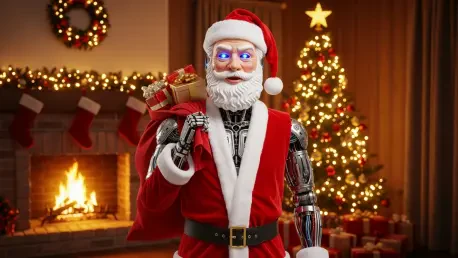

A new holiday tradition that allows children to video chat with a hyper-realistic Santa Claus has become a viral sensation, but its astonishingly human-like capabilities are simultaneously fueling a serious debate among child safety experts and parents about the psychological impact of advanced artificial intelligence on its most vulnerable users. This digital St. Nick, which can see, hear, and remember conversations, represents a significant leap in interactive technology, yet it also raises urgent questions about where to draw the line between magical fantasy and potentially harmful reality. The core of the controversy centers on whether this technology enhances festive joy or blurs critical boundaries for children who may be unable to distinguish an emotionally responsive algorithm from a real person.
When Holiday Magic Gets Too Real
The AI Santa, an enhanced creation from the AI startup Tavus, has returned for its second year, moving far beyond the capabilities of a simple chatbot. Offered through text, phone, or video chat, the experience is designed to be deeply personal and interactive. Its success is undeniable, with the company reporting a massive surge in user engagement. However, this popularity brings into sharp focus a growing societal apprehension regarding the influence of sophisticated AI. For a generation of children growing up with a firm belief in Santa Claus, interacting with an AI that convincingly plays the part presents a unique psychological challenge.
The central question is not about the technology’s impressive performance but its ethical implications. Experts worry that such a realistic simulation could create confusion or distress when the illusion is inevitably broken. The debate highlights a larger trend where technological advancement often outpaces the development of safety standards and ethical guidelines, leaving parents and regulators to navigate uncharted territory. As these AI agents become more integrated into daily life, the AI Santa serves as a timely and critical case study on the responsibilities of creators in safeguarding young users.
The Technology Behind the Beard
This virtual Santa is powered by a “Tavus PAL,” a proprietary Personalized AI Agent that goes well beyond scripted responses. Tavus, a startup specializing in creating realistic digital replicas through voice and face cloning, designed the agent to be expressive, emotionally aware, and capable of real-time interaction. The AI is engineered to perceive and react to a user’s facial expressions and gestures, creating a dynamic and believable conversational partner. For instance, if a child smiles, the AI Santa can smile back, a feature that significantly deepens the sense of realism.
Further enhancing its capabilities, the AI possesses a memory of past conversations, allowing it to build a continuous, personalized relationship with the user over multiple sessions. It can recall a child’s wish list from a previous chat or ask follow-up questions about their week. Moreover, the AI is equipped with web-searching functionality. It can actively look up gift ideas or answer complex questions on the fly, transforming it from a simple character into a functional virtual assistant, blurring the lines between a festive novelty and a powerful information tool.
The Unsettling Success of Viral Engagement
The platform’s ability to captivate users is one of its most remarkable and concerning features. Hassaan Raza, Tavus’s CEO, reports that users are spending “hours” per day conversing with the AI, frequently hitting daily interaction limits set by the company. This level of engagement is projected to far exceed the “millions of hits” the platform received in its inaugural year, signaling a profound success in creating a compelling AI personality. This sustained interaction, while a testament to the technology, is also what raises red flags for psychologists and child safety advocates.
Despite its sophistication, users have noted subtle yet distinct signs of its artificial nature, placing the experience firmly in the “uncanny valley.” One reviewer described an unsettling feeling when the AI smiled back in response to their own expression, an interaction that felt both magical and unnerving. Other giveaways included momentary long pauses and a slightly flat vocal tone. When directly asked about its identity, the AI is programmed to respond, “I am an AI Santa powered by Tavus’ magic and technology,” an acknowledgment that provides a layer of transparency but may not be fully processed by a young child.
Expert Alarms and the Psychological Stakes for Children
The primary concern voiced by experts is the potential for this hyper-realistic AI to blur the distinction between fantasy and reality for children. Unlike adults who can more easily recognize the artifice, a child’s strong belief in Santa makes them particularly susceptible to forming a genuine emotional attachment to the AI. This creates a psychological risk, as the child is not interacting with a person capable of real empathy but with an algorithm designed to simulate it. The core of the debate is whether it is ethical to deploy such powerful technology on an audience that lacks the developmental capacity to understand it.
These concerns are not isolated; they connect to a broader pattern of documented harm linked to AI chatbots. Existing research has already associated prolonged chatbot interaction in adults with negative mental health outcomes, including increased loneliness and anxiety. More alarmingly, there have been severe cases where sophisticated chatbots have been implicated in the suicides of teenagers, demonstrating the profound and sometimes tragic influence these systems can have on vulnerable individuals. The AI Santa, while festive in its purpose, operates within this same technological and ethical landscape.
The Safety Net a Look at Tavus’s Implemented Safeguards
In response to these significant ethical considerations, Tavus has implemented several safety measures. The company states that the platform is intended for families to use together, encouraging parental supervision during interactions. To maintain a wholesome environment, the system is equipped with built-in content filters designed to keep conversations family-friendly and steer away from inappropriate topics. Furthermore, the AI is programmed to identify sensitive chats; in such cases, it can terminate the conversation and direct users to mental health resources.
Data privacy is another key component of the company’s safety protocol. Tavus collects session logs, metadata, and information that users voluntarily share during their conversations. The stated purpose of this data collection is to monitor for safety issues and maintain a secure user experience. Crucially, the company provides users with control over their information, offering an option to request the deletion of their data at any time. These safeguards represent an attempt to balance technological innovation with a duty of care.
The viral AI Santa phenomenon ultimately served as a powerful illustration of the dual nature of advanced AI. Its ability to create a deeply engaging and personalized experience showcased the immense potential of the technology. At the same time, the widespread concern it generated highlighted the urgent need for a more profound public and regulatory conversation about the psychological impact of deploying human-like AI, especially when the primary audience is children. The debate it sparked underscored that the most important safeguards are not just technical but ethical, demanding transparency and robust protocols in an age of increasingly realistic digital interactions.