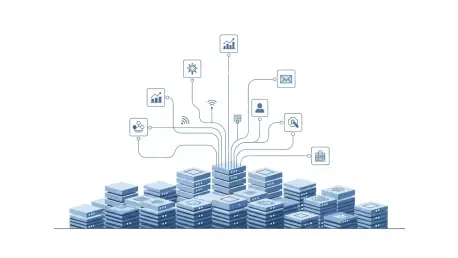

Some market narratives paint a pessimistic picture of Software-as-a-Service: the market is on its last legs. It is one built on volatile earnings reports, revised growth expectations for established providers, and the predictions of sector leaders such as Satya Nadella (who declared in 2024 that “SaaS is dead” on the BG2 podcast).
It is clear now that Software-as-a-Service isn’t facing extinction. It is undergoing a period of metamorphosis that transitions the technology from a passive tool into the intelligent, active core of the digital enterprise. The era of software as a simple “system of record” is over, driven by the integration of agentic artificial intelligence, which allows Software-as-a-Service to evolve into a dynamic “system of action” instead, altering how businesses create and deliver value.
It’s a strategic pivot that enables data to more directly inform decisions, reducing (but not eliminating) the need for constant human intervention. The platforms that were once merely used to store information are now hotspots for innovation and foundations for increasingly autonomous, yet supervised, operations.
For leaders, the challenge is no longer about which software to buy, but about preparing their organizations to thrive an economy increasingly shaped by intelligent workflows and AI-driven systems.
From a System of Record to a System of Action
Historically, enterprise Software-as-a-Service platforms, such as Enterprise Resource Planning or Customer Relationship Management ones, served one primary function: to capture and organize vast quantities of business data that could later be leveraged by analysts for decision-making. They were indispensable systems of record, providing a single source of truth for everything relevant to an organization’s daily operations, from financial transactions to customer interactions.
But there was always a catch: Their value and return on investment depended entirely on human intervention, expertise, and action.
In the age of artificial intelligence, this model is becoming obsolete. The emerging agent economy means that while the foundational role remains critical, it now has the means to hold a much larger role in enterprise operations. The value no longer lies in storing data, but in how intelligent agents use said information to automate processes and drive more proactive decisions.
In a relevant example, a Customer Relationship Management platform that holds customer data functions as a primarily as a centralized system of record. A Customer Relationship Management system that is powered by artificial intelligence agents uses it actively to anticipate customer needs, schedule follow-ups, and draft outreach autonomously.
The transition is linear: passive data repositories become engines of business value. The ultimate goal is for these platforms to become measurable systems of productivity and performance, where their contribution is directly tied to the business outcomes they enable. They will no longer track what happened; they will make things happen.
Building a Defensible Moat in the AI Era
Advanced artificial intelligence tools have dramatically lowered the barrier to entry for software development, lowering traditional competitive advantages like engineering complexity. The new imperative for competitiveness isn’t about building feature-rich products, but about creating a defensible, compounding system that competitors cannot easily replicate. That means adopting a new moat defined by two interconnected pillars that create a self-reinforcing loop of intelligence and value.
The first one is intelligent orchestration. Foundational artificial intelligence is becoming commoditized, meaning that differentiation comes from the proprietary sequence in which they are combined to solve a specific business problem. The result is a unique “recipe” that becomes the core intellectual property, creating a product experience difficult to reverse-engineer.
The second one is a data flywheel, which amplifies the former point. Every customer action generates unique, domain-specific data that drives artificial intelligence model training and refinement, enhancing performance for all users. A competitor can easily copy a user interface, but they cannot successfully replicate the accumulated history of labeled decisions and nuanced operational data. In the long term, competition will be won by whoever builds the most effective data flywheel.
The Unseen Hurdle: Why Data Maturity Is Non-Negotiable
The promise of an AI-driven agent economy is compelling, but there is a crucial pain point standing in the way: most organizations aren’t ready for this transformation. The transition is entirely contingent on data maturity, a factor that is often overlooked in the rush to adopt new technology.
Analysis consistently shows that the majority of business intelligence and artificial intelligence initiatives fail to deliver the expected return on investment. The key differentiator for successful organizations is not their adoption of the latest tools, but their commitment to the unglamorous work of industrializing their data infrastructure. This means establishing robust practices for data quality, integration, and scalability.
Without this important level of data maturity, any implementation of sophisticated any AI-driven systems goes to waste. Consider this scenario: a global logistics company operates with a legacy Customer Relationship Management platform, a passive record of shipments and customer contacts. After investing in a data maturity program, the cleansed and newly structured data allows the intelligent capabilities that are next implemented to take over. The framework can now recommend optimized routing decisions based on real-time weather patterns, shifting market demands, and port congestion levels, reducing delays and improving operational performance.
It’s a technological wave that does not require a “rip-and-replace” strategy, but a disciplined focus on strengthening the data infrastructure within existing Software-as-a-Service tooling before adding upgrades. For Chief Information Officers, the priority is making astute bets that deliver long-term value, which begins with creating a stable launchpad for future artificial intelligence innovation.
The Path Forward
The debate over the future of Software-as-a-Service is an ongoing one. Some sector experts consider obsolescence, while others continue to see a bright future for the industry.
What remains clear? Software-as-a-Service is experiencing a redefinition of its purpose. Platforms aren’t being replaced, but they are becoming the indispensable data layer upon which the next generation of business value will be built. This shift is already creating tension among technology leaders and investors. Enterprises must move beyond surface-level application features and focus on data maturity and intelligent orchestration. These capabilities will define market leadership over the next decade.
Navigating this transition requires a clear-eyed approach. The excitement for innovation is justified, but it cannot come at the expense of foundational readiness. The path to a more autonomous enterprise is a marathon, not a sprint, built on disciplined investment and strategic foresight.