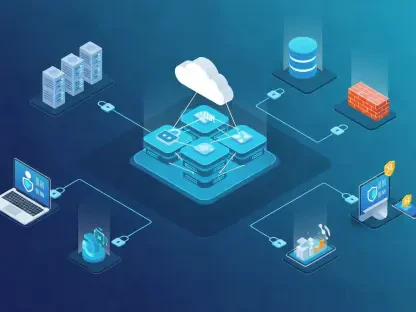

The long-predicted convergence of sophisticated cyber threats and deep-seated systemic fragility is no longer a future scenario but the defining operational reality of the year, creating an environment where widespread disruption is not a possibility but an inevitability. As organizations finalize their digital transformation journeys, they find themselves standing on a foundation that is both incredibly powerful and alarmingly brittle. The collision of these forces is creating unprecedented challenges for business leaders and security professionals, demanding a fundamental re-evaluation of risk, resilience, and the very architecture of our shared digital world.
The Hyper-Converged Cloud a Landscape of Unprecedented Interdependence
The global digital ecosystem is now built upon a highly centralized infrastructure, characterized by an overwhelming reliance on a small cadre of hyperscale cloud providers. Industry giants like Amazon Web Services, Microsoft Azure, and Google Cloud are no longer mere vendors; they are the utility providers for the modern economy. Their platforms form the bedrock upon which nearly every business operates, from nimble startups to sprawling multinational corporations. This consolidation extends beyond core computing to essential internet services like Cloudflare, which acts as a critical gateway and defender for a significant portion of the web.
This architecture has created a hyper-converged environment where the lines between organizations are blurred by a vast, interconnected web of Software-as-a-Service (SaaS) applications. Business processes, data flows, and operational dependencies are now woven through countless third-party services, creating a complex tapestry of shared risk. The result is a system of unprecedented interdependence, where a vulnerability in one small SaaS provider can have cascading effects across thousands of its customers, and an outage at a single hyperscaler can bring entire economic sectors to a standstill.
Vectors and Velocities Emerging Threats and Future Shockwaves
The SaaS Supply Chain The New Soft Underbelly of Enterprise Security
Threat actors, driven by efficiency and scalability, have strategically shifted their focus from heavily defended corporate perimeters to the sprawling and often-insecure third-party SaaS supply chain. This approach represents the path of least resistance, transforming a single compromised vendor into a skeleton key that unlocks thousands of downstream customer environments. This “one-to-many” attack model offers a massive return on investment, exploiting the implicit trust that organizations place in their software partners.
The problem is critically magnified by the business models of many SaaS providers, where essential security features like multi-factor authentication or access to audit logs are often positioned as premium, paid add-ons. This practice leaves a significant portion of the ecosystem operating with weak security defaults, creating vulnerabilities that are inherited by every organization they connect with. Furthermore, adversaries are now leveraging artificial intelligence to automate and accelerate vulnerability discovery, dramatically reducing the time between the identification of a flaw and its exploitation. This new velocity of attack necessitates a corresponding increase in the speed of defense, forcing security teams into a constant race to secure their foundational postures.
Forecasting the Fallout Quantifying the Risk of Systemic Collapse
The financial and operational consequences of this systemic fragility are becoming starkly clear. Major service outages, like those that impacted services from OpenAI to Cloudflare last year, are increasing in both frequency and severity, costing the global economy billions in lost revenue and productivity. These incidents are no longer isolated technical failures but predictable outcomes of an architectural philosophy built on single-cloud dependence. The assumption that hyperscale providers will always remain online is a flawed premise that has led to a lack of genuine resilience in system design.
Data-driven projections show a continued upward trend in the economic damage resulting from successful supply chain attacks and widespread outages. Performance indicators reveal a growing over-reliance on single-cloud architectures across critical industries, quantifying the scale of the problem. As threat actors evolve their tactics to include direct, cloud-native ransomware attacks targeting services like Microsoft 365, the potential for catastrophic data loss and business disruption escalates. The quantitative risk models now clearly demonstrate that the cost of reactive incident response far outweighs the investment in proactive, resilience-by-design architectures.
Confronting Critical Dependencies The Monoculture and the Skills Gap
The core weakness of the modern internet lies in its emerging “internet monoculture.” The consolidation of services around a handful of key providers has created a homogeneous technological landscape. While this standardization offers efficiencies, it also introduces systemic risk on a global scale. A single vulnerability or misconfiguration at one of these central hubs can trigger a domino effect, leading to catastrophic, widespread outages. This lack of diversity eliminates the natural resilience found in more heterogeneous systems, making the entire ecosystem more susceptible to a single point of failure.
Compounding this architectural fragility is a growing skills gap in foundational technologies. As some organizations begin repatriating critical workloads from the public cloud to on-premise or hybrid environments—driven by concerns over costs, data sovereignty, and performance—they are discovering a shallow talent pool. Years of focus on cloud-native skill sets have led to a decline in deep expertise in traditional areas like networking, storage, and core systems engineering. This shortage creates a significant operational risk, as companies build complex hybrid architectures without the requisite talent to manage and secure them effectively.
Navigating the New Rules of Engagement Compliance in an Age of Shared Risk
The regulatory landscape is struggling to keep pace with the reality of a shared-risk digital ecosystem. Data sovereignty laws, which mandate that citizen data be stored within national borders, are a primary driver behind the adoption of hybrid cloud models. These regulations are forcing organizations to re-architect their global operations while simultaneously increasing pressure on them to enforce stringent security standards not only within their own walls but across their entire third-party vendor ecosystem. This creates a complex compliance challenge where an organization’s legal standing is directly tied to the security posture of its smallest SaaS provider.
A more immediate and disruptive challenge is unfolding right now, as the industry-wide mandate to shorten Transport Layer Security (TLS) certificate lifespans from 398 days to just 200 days takes full effect. This quasi-regulatory change, intended to improve security by forcing more frequent key rotation, is creating significant operational chaos. A digital certificate acts as a machine’s identity, and when it expires, trusted communication ceases. With expiration events now occurring nearly twice as often, organizations relying on manual tracking methods are being overwhelmed, leading to a cascading series of outages across critical systems, from financial transaction networks to logistics and supply chain platforms.
Beyond 2026 The Dawn of Resilience by Design
Surviving in this new era requires a strategic pivot away from a singular focus on breach prevention and toward a philosophy of resilience by design. The flawed assumption that any single provider or platform is infallible is being replaced by the sober acknowledgment that outages and attacks are inevitable. Consequently, leading organizations are moving away from single-cloud dependence and are intentionally designing multi-cloud and hybrid architectures that prioritize business continuity above all else. This approach ensures that applications, data, and security controls can failover seamlessly between environments, maintaining operations even when a major provider is offline.
This paradigm shift necessitates investment in new capabilities and technologies. Automated machine identity management is becoming critical for navigating the chaos of shortened certificate lifespans, replacing manual spreadsheets with intelligent systems that can manage the entire lifecycle of a certificate without human intervention. Furthermore, security teams are adopting a “velocity-focused” posture, prioritizing the speed at which they can identify, assess, and remediate risks across their sprawling SaaS supply chains. The ultimate goal is no longer to build an impenetrable fortress but to create an agile, resilient enterprise that can withstand persistent disruption and continue to deliver on its core mission.
A Strategic Imperative Fortifying the Future Against Inevitable Collision
The analysis in this report identified that a collision of sophisticated cyber threats and deep-seated systemic fragility had become the defining operational reality. The findings pointed to several primary risks that converged to create an environment of persistent digital disruption. These included the strategic targeting of the third-party SaaS supply chain, the rise of direct cloud-native attacks, the inherent fragility of the internet’s monoculture, and the widespread operational chaos driven by compressed certificate lifespans.
In response, the report underscored a set of actionable recommendations for CISOs and business leaders who aimed to navigate this landscape. It was emphasized that organizations needed to prioritize rigorous security audits of their entire supply chain, moving beyond simple compliance checklists to conduct deep, technical assessments. The imperative was clear: leaders had to shift investment from purely preventative measures toward building true, architectural resilience by design. Finally, it was concluded that preparing operational teams—through training, automation, and process refinement—was essential for surviving in a new era where business continuity depended on the ability to withstand inevitable attacks and outages.