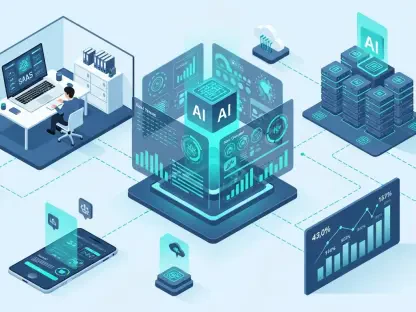

The recent stabilization of the global software market marks a definitive departure from the chaotic speculation that once threatened to dismantle the foundational pillars of the enterprise technology sector. This transition, occurring throughout the opening months of the current year, signifies a move away from the destructive SaaSpocalypse and toward a period characterized by deep integration and structural resilience. The frantic energy that defined earlier development cycles has been replaced by a grounded realization that artificial intelligence serves as an accelerant for existing infrastructure rather than a total replacement for the software tools that businesses have spent decades perfecting.
The shift in the market trajectory became evident as major cloud platforms and software providers successfully defended their relevance against the perceived threat of autonomous agents. Systems of Record, represented by long-standing giants such as Salesforce and HubSpot, have effectively transitioned from being potential victims of automation to becoming the essential data conduits for intelligent models. These platforms maintain their market dominance because they hold the deep historical context and organizational data that newer, isolated AI tools simply cannot replicate. Instead of the predicted collapse, the industry witnessed a reinforcement of the traditional software stack, enhanced by a layer of generative intelligence that respects the existing hierarchy of enterprise workflows.
Financial stability in this new era is largely anchored by massive compute and infrastructure partnerships that link the success of AI labs to the health of the broader technology economy. Significant capital injections and infrastructure deals involving Amazon and Google have created a symbiotic relationship where the growth of model capabilities directly fuels the expansion of cloud services. This dynamic has provided a necessary floor for market valuations, reassuring investors that the move toward high-level intelligence is a capital-intensive journey that favors established players with the scale to support it. The resulting market equilibrium reflects a more mature understanding of the costs and requirements associated with deploying enterprise-grade intelligence at a global scale.
Furthermore, the general perception of technological progress has evolved from a speculative fever centered on human replacement to a more structured framework of human-centric productivity. Organizations are no longer looking for a silver bullet to eliminate headcount but are instead seeking tools that can alleviate the cognitive load on their most valuable employees. This psychological shift has allowed the industry to move past the initial shock of disruption and into a phase of deliberate, strategic implementation where the human worker remains the central decision-maker in the loop.
Emerging Trends and the Economic Reality of AI Integration
The Strategic Pivot Toward Human-in-the-Loop Systems
The rise of collaborative intelligence is best exemplified by the deployment of Claude 4, which champions a workflow model often referred to as a sandwich of human intent. This approach requires a human to initiate a task with specific context, allows the model to perform the heavy lifting of execution, and concludes with a human review for final verification. Such a structure ensures that while the speed of output increases exponentially, the ultimate accountability and creative direction remain firmly in human hands. This model has redefined workplace expectations, moving the needle from total autonomy toward a more reliable form of assisted excellence.
Modern enterprise strategy now favors task fragmentation over the more radical concept of total automation. Instead of attempting to replace an entire job description with a single model, companies are breaking down complex roles into specific, addressable components that can be enhanced by targeted intelligence. This modular approach allows for a more seamless transition, as employees learn to delegate repetitive or data-heavy tasks to their digital assistants while focusing their own efforts on strategy and nuanced problem-solving. It is a refinement of the workflow that respects the complexity of modern business operations.
Consumer behavior within the enterprise has also shifted toward a preference for AI that integrates quietly with the existing IT stack. There is a growing resistance to standalone tools that require significant behavior changes or new silos of data. Decision-makers are prioritizing software that brings intelligence directly to the environment where the work is already happening, whether that is a customer relationship management platform or a specialized financial tool. This preference for integration over replacement has effectively saved the traditional SaaS model from obsolescence by making it the primary delivery vehicle for advanced intelligence.
Performance Indicators and the Anthropic Economic Index
To accurately quantify the impact of these technologies, the implementation of data-driven metrics like the Anthropic Economic Index has become essential for tracking productivity across the Fortune 500. This index provides a clear view of how AI integration correlates with output gains without the corresponding mass labor displacement that many feared. By focusing on metrics like time-to-completion for complex reports and the accuracy of automated data entry, businesses can now see a tangible return on investment that justifies their continued commitment to the augmented enterprise model.
Forecasts for the upcoming fiscal cycles suggest a strong valuation trajectory for platforms that prioritize a human-first approach to intelligence. The era of the augmented enterprise is expected to drive a new wave of market growth as companies find ways to unlock value from their existing data sets through more intelligent interfaces. This projected growth is not based on the destruction of old industries but on the optimization of current ones, creating a more sustainable and predictable path for long-term investors who were previously wary of the volatility associated with raw AI disruption.
The recovery of the WisdomTree Cloud Computing Fund serves as a powerful indicator of this renewed investor confidence in the software sector. After a period of intense skepticism, the rebound of this fund suggests that the market has processed the initial threat of AI and concluded that cloud-based software remains the most viable delivery mechanism for enterprise value. This stabilization has paved the way for a more disciplined investment environment where the focus has returned to sustainable growth, recurring revenue, and the successful integration of advanced intelligence into proven business models.
Navigating the Obstacles of the New AI Order
The erosion of point solutions has become one of the most significant challenges for the startup ecosystem as broad-spectrum models become more capable. Niche tools that once solved simple problems, such as basic transcription or simple code completion, are finding their value propositions rendered obsolete by the native capabilities of large-scale models. This consolidation is forcing a thinning of the herd, where only those startups that can offer deep, proprietary moats or highly specialized vertical expertise can survive. The market no longer rewards simple wrappers around existing models, demanding instead a unique contribution to the workflow.
Data context remains the primary obstacle for any organization attempting to make AI truly effective within a professional setting. While a model may possess immense general knowledge, it lacks the specific, historical data that resides within the legacy systems of an established corporation. Bridging this gap requires sophisticated data pipelines and a commitment to maintaining a system of record that the AI can reliably draw upon. Organizations that have neglected their data hygiene are finding that their AI implementations are less effective, highlighting the fact that intelligence is only as good as the context it is provided.
Ensuring the reliability and safety of these systems is a constant battle against the inherent risks of errors and hallucinations. Within critical business infrastructure, a single mistake in a financial forecast or a legal summary can have catastrophic consequences. As a result, companies are investing heavily in verification layers and safety protocols that act as a buffer between the raw output of the model and the final business decision. This focus on reliability is not just a technical requirement but a core business strategy that determines the level of trust an organization can place in its automated systems.
Governance, Compliance, and the New Regulatory Standard
Proactive self-regulation has emerged as a key strategy for maintaining a favorable operational environment. By embedding human oversight and ethical guardrails directly into their product architecture, leading AI labs are setting a standard that aims to preempt more restrictive and potentially stifling government legislation. This approach demonstrates a commitment to responsible development that aligns with the safety requirements of the world’s largest organizations. It creates a blueprint for how a high-growth technology sector can navigate complex societal concerns while continuing to innovate at a rapid pace.
The emergence of AI auditing has become a professional necessity, creating a new market for tools and services that verify decisions against both ethical and corporate benchmarks. Businesses are now required to prove that their automated processes are fair, transparent, and compliant with increasingly stringent data privacy laws. This has led to the development of sophisticated monitoring platforms that track every interaction, providing a transparent audit trail for regulators and internal stakeholders alike. The goal is to move from a black-box model of intelligence to one that is fully accountable to the organization it serves.
Specialized deployments like Claude Gov are addressing the unique security and compliance needs of high-stakes industries, including defense and intelligence agencies. These isolated environments allow for the power of advanced intelligence to be harnessed without compromising the strict data sovereignty required for national security. By providing a secure path for sensitive organizations to adopt these tools, providers are expanding their market reach into sectors that were previously considered too risky for cloud-based AI. This high-level security focus is becoming a standard expectation for any platform operating at the enterprise level.
The Future of Innovation: Beyond Large Language Models
The next wave of market disruption will likely focus on the seamless orchestration of vast fleets of AI agents rather than the raw power of individual models. As businesses move from using a single assistant to managing dozens of specialized digital entities, the challenge shifts toward coordination and oversight. Companies that can provide the “managerial” layer for these agents will become the next generation of essential enterprise software. This transition marks the move from simple interaction to complex, multi-agent workflows that can handle entire business processes with minimal human intervention.
As these technologies become more pervasive, there is a clear shift in the skills required for professional success, with AI orchestration becoming a core competency for mid-level management and executives. The ability to direct, audit, and refine the output of multiple intelligent systems is now as important as traditional leadership or technical expertise. Education and training programs are being redesigned to prepare the workforce for a reality where their primary role is to act as the conductor of a digital symphony, ensuring that the various technological components work in harmony to achieve business goals.
The stabilization of the software sector through these advancements has a profound impact on global economic resilience. By preventing a broader cooling of the technology market, the successful integration of human-first intelligence fosters a climate of long-term innovation and productivity. This stability allows for continued investment in R&D and infrastructure, ensuring that the technology sector remains a primary driver of global wealth. The move toward augmentation has turned a potential economic crisis into a period of sustainable growth that benefits both the creators of these tools and the organizations that deploy them.
Concluding the Era of Stability and Growth
The transition toward a collaborative framework for artificial intelligence effectively ended the immediate threat to the software-as-a-service industry by prioritizing partnership over replacement. This strategic pivot allowed legacy platforms to maintain their central roles as data curators while adopting the efficiencies offered by modern models. The narrative shifted from a zero-sum game between humans and machines to a more nuanced reality where the most successful organizations were those that leveraged technology to empower their workforce. This consensus brought a sense of predictability back to a market that had been defined by extreme volatility and speculative fear.
The winners in this new landscape proved to be those who embraced a safety-first and integration-focused approach. Cloud infrastructure giants solidified their dominance by becoming the indispensable backbone of the AI economy, while integrated SaaS platforms successfully defended their moats by becoming the primary interfaces for intelligent work. These entities moved beyond the experimental phase and delivered tangible value through reliability and context-driven insights. The labs that focused on human-centric design emerged as the primary partners for the world’s most sensitive and complex industries, securing their positions as long-term market leaders.
Future growth in the augmented enterprise will likely be measured by the depth of AI orchestration and the efficiency of human-machine workflows. Investors should look beyond raw processing power and focus on companies that possess proprietary data assets and the ability to maintain a high degree of human oversight. The successful navigation of the current year provided a template for how the technology sector can evolve without triggering systemic collapse. Moving forward, the emphasis remains on developing tools that enhance human decision-making, ensuring that the evolution of intelligence remains a steady and productive force in the global economy.