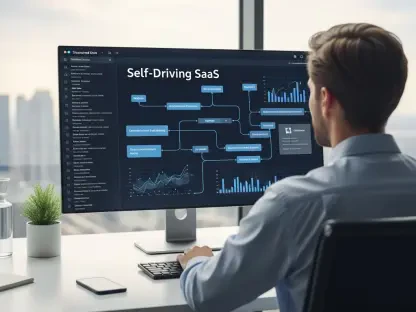

Our SaaS and Software expert, Vijay Raina, joins us today to dissect the seismic shifts occurring in the enterprise technology landscape. With AI challenging the very definition of software and Wall Street reevaluating the entire SaaS category, leaders are drawing bold lines in the sand. We’ll explore the aggressive strategy of platform companies aiming to become “great consolidators,” the critical distinction between a true platform and a simple SaaS application, and how the unpredictable nature of AI is being harnessed within the rigid structure of enterprise workflows. This conversation will unpack the future of how businesses operate, innovate, and compete in the burgeoning AI Economy.
You’ve described a future where AI consolidates smaller “features and functions” companies. What specific types of software are most vulnerable to being absorbed, and how does a platform approach actually integrate their capabilities? Please provide a step-by-step example of this consolidation in action.
Absolutely. The most vulnerable software vendors are those offering point solutions that perform a single, isolated task—what Bill McDermott aptly calls “features and functions companies.” Think about standalone tools for expense reporting, simple IT ticketing, or niche project management. They do one thing well, but they don’t talk to the rest of the business. The platform approach, like what ServiceNow is championing, doesn’t just buy these companies; it renders their isolated nature obsolete. A platform acts as a connective tissue, an “AI Control Tower,” that weaves these functions into a single, intelligent process.
For a concrete example, imagine a new employee onboarding process. Traditionally, a company might use one tool for HR paperwork, another for IT equipment provisioning, and a third for facilities access. It’s a clunky, multi-step ordeal. The platform consolidation looks like this: Step one, the platform ingests the new hire data. Step two, an AI-powered workflow automatically triggers tasks across all departments simultaneously—it orders the laptop, creates the user accounts, and schedules orientation, all within one unified system. The “features” of the old apps are now just steps in a seamless, end-to-end business process. This is what it means to be the “great consolidator”—it’s not about M&A, it’s about making the whole greater than the sum of its siloed parts.
Many investors have lumped platform companies in with the broader SaaS category. Beyond valuation, what are the fundamental operational and customer outcome differences that separate a true platform from a traditional SaaS product? Could you share some specific metrics that illustrate this distinction?
It’s a source of immense frustration for these platform leaders, and for good reason—the difference is night and day. A traditional SaaS product is designed to solve a specific, functional problem. Think of it as a high-quality hammer; it’s excellent for nails but not much else. The customer outcome is isolated efficiency in one department. A true platform, on the other hand, is like a complete, intelligent workshop. It provides the tools and, more importantly, the workbench and assembly line to connect disparate processes and build entirely new solutions. The customer outcome isn’t just efficiency; it’s business reinvention.
The metrics tell this story clearly. While a SaaS company might focus on user adoption within a single team, a platform’s health is measured by its ecosystem’s breadth and the growth in cross-departmental workflows. Look at ServiceNow’s numbers: a 25% year-over-year increase in monthly active users isn’t just about more people logging in; it reflects the platform spreading horizontally across the enterprise. Furthermore, metrics like current RPO growing 25% to $12.85 billion and remaining RPO up 26.5% to $28.2 billion signal deep, long-term strategic commitments from customers. They aren’t just buying a tool; they are investing in a new operating model for their entire business.
Given the contrast between probabilistic AI and deterministic workflows, how do you practically merge these two concepts to create reliable, governed business processes? Can you walk us through how an “AI Control Tower” functions in a real-world enterprise scenario to manage this?
This is the most critical challenge and the greatest opportunity in enterprise AI today. AI is probabilistic; it makes educated guesses and predictions, which is fantastic for insight but terrifying for core business operations that demand certainty. Workflows, however, are deterministic; they follow a predictable, unchangeable script. You can’t run a global supply chain or a financial close process on a “maybe.” The merger happens when you use one to guide the other within a governed framework. The “AI Control Tower” is the perfect metaphor for this.
Imagine an inventory management scenario. The probabilistic AI analyzes thousands of data points—market trends, weather patterns, social media sentiment—to predict a potential surge in demand for a product. It doesn’t act on its own. Instead, it alerts the deterministic workflow inside the control tower. The workflow, which has pre-defined rules and governance, then executes the necessary actions: it checks current stock, places a purchase order with an approved supplier, and notifies the logistics team. The AI provides the “what” and the “why,” but the deterministic workflow provides the safe, predictable, and auditable “how.” AI doesn’t replace the orchestration; it depends on it to turn a smart guess into a reliable business outcome.
With monthly active users growing 25% and a target market of 1.3 billion seats, what is the core value proposition you are using to penetrate this vast, untapped market? What key industries or business functions are you prioritizing for this expansion?
The core value proposition is powerful and simple: ServiceNow offers a single platform to simplify the overwhelming complexity of modern business. Companies are drowning in a sea of disconnected applications and siloed data. The pitch is that you can stop buying dozens of niche “feature” products and instead invest in one strategic platform that connects everything. This message of consolidation and simplification is resonating deeply, which is why you see that impressive 25% growth in monthly active users. They’re demonstrating that the platform can serve as the semantic layer that makes AI useful across the entire enterprise, not just in isolated pockets.
To tackle a market of 1.3 billion seats, you have to prioritize. Initially, the focus has been on IT and customer service workflows, as these are natural fits. However, the major expansion is happening horizontally into functions like HR, finance, and core operations. Industries with complex, multi-step processes are prime targets—think financial services, healthcare, and manufacturing. The goal is to become the indispensable operating system for any large organization trying to navigate digital transformation. They’ve barely scratched the surface, and the strategy is to prove the model in one part of a business and then expand across it, one workflow at a time.
What is your forecast for the enterprise software market over the next five years, especially concerning the role of Agentic AI?
My forecast is one of radical transformation and consolidation. The era of the single-function SaaS application as a primary growth driver is ending. Over the next five years, Agentic AI will become the central nervous system of the enterprise, but it won’t operate in a vacuum. It will be embedded directly into workflow platforms that provide the necessary governance and scale. We’ll see a clear bifurcation in the market. On one side, you’ll have a handful of dominant, strategic platforms—the “Great Consolidators”—that orchestrate end-to-end business processes. On the other, you’ll have a graveyard of smaller “feature” companies whose functionalities have been absorbed and commoditized by these platforms. Agentic AI will accelerate this, acting as the catalyst that devours busywork and elevates platforms from tools of efficiency to engines of true business reinvention. The real winners won’t be the companies that build the cleverest AI models, but those that successfully weave them into the fabric of how business gets done.