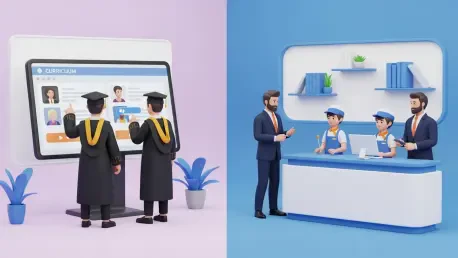

Our expert today, Vijay Raina, brings a deep understanding of enterprise SaaS technology and software architecture. He joins us to dissect a fascinating shift in the workforce training landscape, particularly in emerging markets like India, where the rise of AI is creating a powerful counter-movement toward upskilling human-centric, “grey-collar” jobs. We’ll explore a unique business model that partners with universities and major employers to bridge the persistent skills gap, creating job-ready graduates for industries AI can’t replace.
You’ve identified a niche in training for roles resistant to AI, such as nursing and hospitality. What is your framework for identifying these “grey-collar” jobs, and how do you convince universities to prioritize them over more traditional degree paths? Please share your process.
Our framework is fundamentally about identifying where technology acts as an assistant, not a replacement. We look for roles that are credentialed and require an indispensable human, hands-on element. Take nursing, for example. We asked ourselves, can AI perform the administrative tasks of a nurse, like updating electronic medical records? Absolutely, and it will make them more efficient. But can AI replace the nurse needed at a patient’s bedside in the ICU, where staffing ratios are critical? No. That’s our filter. These are the “grey-collar” roles we target. Convincing universities isn’t about telling them to abandon traditional degrees. Instead, we show them the glaring demand-supply gaps, like the 55% to 60% shortfall in hospitality, and how their graduates are struggling. We then offer a turnkey solution: an employer-designed, job-ready program that we help integrate directly into their existing curriculum, making their degrees exponentially more valuable to both students and the industry.
Your business model is unique, as you don’t charge major employers like Fortis Healthcare or Taj Hotels. Could you walk me through the decision to charge partner universities instead and explain how this structure helps you maintain an 80% gross margin and low acquisition costs?
It was a strategic decision rooted in aligning incentives. The major employers provide the most valuable asset: the precise blueprint of the skills they need. By not charging them, we get their unfiltered, enthusiastic participation in co-designing the curriculum. The universities, in turn, are our primary partners and revenue source because we are directly solving their biggest problem: student employability. They are struggling to place graduates, and we bring them a direct pipeline to top-tier employers. This creates a powerful symbiotic relationship. This model is incredibly efficient. We maintain gross margins around 80% because our core offering is curriculum and training infrastructure, which scales well. Furthermore, by embedding ourselves within the university system and leveraging a career counseling platform that generated over 350,000 inquiries last year, our customer acquisition cost stays below 10% of revenue. We don’t need to spend heavily on performance marketing; the universities and students come to us.
Your journey began after observing highly qualified graduates seeking entry-level jobs. How does that insight inform your curriculum co-design process, and what specific, practical changes are you making to university programs to prevent this skills mismatch for future graduates? Please provide an example.
That observation was the spark. Seeing engineers and PhDs applying for basic government jobs was a visceral sign of a broken system. These students had spent years and a fortune on degrees that left them unprepared for the real world. That insight is now the core of our entire process. We don’t just advise universities; we embed ourselves with them and their industry partners. For a nursing program, for example, we won’t just suggest a new textbook. We work directly with hospital groups like Apollo and Fortis to understand the exact procedures and patient-care protocols their new hires need on day one. Then, we build that into the university’s program, setting up hands-on simulation labs for clinical and emergency care on campus. This way, students aren’t just learning theory; they are practicing the precise skills their future employer requires, using the same types of equipment, long before they graduate.
With plans to expand to over 200 locations and enter new sectors like manufacturing, how will you adapt your training model? Detail the steps you’ll take to ensure your hands-on training and simulation labs remain effective and standardized across different industries and geographies.
The beauty of our model is its adaptability. The core principles remain the same regardless of the industry. The first step is always partnering with the industry leaders—just as we did with hotels and hospitals, we are now in advanced talks with one of India’s top EPC companies. They define the required skills. The second step is translating that into a standardized, deployable curriculum and training infrastructure. For manufacturing, this won’t be a nursing simulation lab, but it will be a workshop that replicates the modern factory floor with specific machinery and quality control processes. To ensure consistency across 200 locations, we rely on a centralized curriculum design team and a robust “train-the-trainer” program for our 200-plus trainers. This ensures that a student in any of our 40-plus affiliated campuses receives the exact same high-quality, employer-approved practical education.
India faces its own significant healthcare worker shortages, yet you see an opportunity in aging markets like Japan and Germany. What specific steps must you take to adapt your training for international standards, and how would you balance meeting domestic needs with serving global demand?
It’s a delicate balance, but not a mutually exclusive one. The foundation of quality healthcare training is universal. The first step for international adaptation is a rigorous process of curriculum mapping. We would need to align our training modules with the specific credentialing and regulatory requirements of markets like Japan and Germany. This involves integrating international best practices, specific medical protocols, and potentially language and cultural competency training. Initially, our focus remains squarely on India, where the need is immense. However, by building a pipeline of exceptionally well-trained healthcare professionals, we will eventually be in a position to help our graduates access global opportunities. This doesn’t mean diverting talent away from India; it means elevating the standard of training so high that our graduates are qualified to serve anywhere, creating a larger, more skilled talent pool that can meet both domestic and international demand over the long term.
What is your forecast for the future of workforce development in India, especially at the intersection of AI and hands-on jobs?
I believe we are at the beginning of a major realignment. For decades, the focus was on purely academic or white-collar degrees. Now, the market is showing us that was an incomplete picture. My forecast is that AI will accelerate the demand for skilled, “grey-collar” professionals, not diminish it. AI will handle the routine, the data entry, the scheduling, and the analysis, freeing up humans to do what we do best: empathize, problem-solve creatively, and perform complex, hands-on tasks. The future of workforce development in India will be a hybrid model where university education is deeply integrated with practical, industry-certified skills training from day one. The most valuable worker of the next decade won’t be the one who can compete with AI, but the one who can masterfully leverage it while providing the irreplaceable human touch that industries will always pay a premium for.