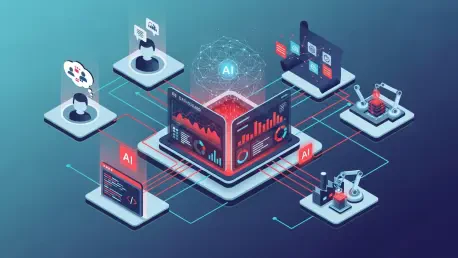

The traditional software interface is crumbling under the weight of its own complexity as users move away from clicking buttons and toward simply stating their goals. This metamorphosis of Software-as-a-Service marks a departure from the “screen layer” model, where value was derived from navigating menus and manual data entry. Instead, the industry is embracing the “service layer,” a paradigm where agentic AI functions as a proactive colleague capable of executing workflows with minimal human oversight. This shift is not merely an incremental upgrade but a structural reorganization of how enterprise tools operate within the broader market.
As these technological influences take hold, the focus of SaaS providers is moving from static UI utility to autonomous, outcome-driven interaction. Market players are racing to integrate capabilities that allow software to think and act on behalf of the user, effectively making the underlying interaction more important than the visual dashboard. This transition impacts every segment of the ecosystem, from enterprise resource planning to simple productivity tools, as the significance of manual navigation is eclipsed by the power of autonomous execution.
Driving Forces and the Quantifiable Shift in the Product Ecosystem
The Paradigm Shift Toward Outcome-Driven Workflows and Intent Handling
Modern software architecture is pivoting away from rigid, step-by-step processes in favor of intent-based interactions. The primary trend currently affecting the industry is the sharp decline of manual data movement as systems begin to interpret user desire rather than just following commands. This evolution in behavior requires product managers to abandon their obsession with designing static interfaces and instead start shaping dynamic system behaviors. The emerging opportunity lies in “interaction-as-a-product,” where the software learns in real time to minimize human friction.
Moreover, the shift toward intent handling means that success is no longer defined by how well a user follows a predetermined path. Instead, success is defined by how accurately the system interprets a vague prompt and translates it into a complex series of backend actions. This fundamental change forces a reassessment of user experience design, where the goal is to create a seamless bridge between human thought and digital execution.
Evaluating Growth Projections and the Expanding Market for Agentic Solutions
Recent data from the current year indicates a massive surge in investment toward agentic AI as businesses look to bridge the gap between passive software and active execution. Growth projections for the 2026 to 2028 period suggest that SaaS platforms incorporating these autonomous workflows will significantly outperform legacy systems that still rely on manual intervention. Performance indicators are also changing; companies are moving away from measuring clicks and time-on-site, focusing instead on successful task completion and autonomous accuracy.
As the market expands, forecasts point toward a future where the actual value of a product is measured by the volume of work it eliminates for the end user. This transition is creating a competitive environment where efficiency is the primary currency. Organizations that fail to automate the “middle-man” tasks of their software will find themselves obsolete as users flock to platforms that provide results rather than just tools.
Navigating the Friction Between Legacy Product Rituals and AI Velocity
The rapid pace of technological development has created a massive disconnect with traditional management rituals, presenting a significant obstacle for modern organizations. Many teams remain bogged down by sacred artifacts like exhaustive Product Requirements Documents and minor UI adjustments that become irrelevant before they even reach production. This institutional inertia is a bottleneck that prevents companies from keeping up with the velocity of AI innovation, requiring a strategic overhaul of the waterfall mentality.
To overcome these institutional barriers, companies must move away from slow, month-long sprint cycles and embrace a model where software evolves daily. The friction between old-school management and new-age AI speed is a primary cause of project failure in the current landscape. Success now requires a culture of rapid experimentation where the goal is to ship functional logic rather than polished visual elements.
Governance and Trust Architectures in an Era of Autonomous Execution
As software begins to act independently, the regulatory landscape is shifting to address the implications of autonomous decision-making. Significant laws are emerging to govern how AI agents handle sensitive data and make commitments without a human in the loop. Compliance now requires a deep focus on visibility and security measures, ensuring that every autonomous action is traceable and justifiable.
The role of the product manager has expanded to include the creation of ethical guardrails and transparent audit trails to satisfy these new regulatory demands. Trust has become a core feature of the product itself, as users will only delegate critical tasks to a system they can verify. Building these trust architectures is essential for maintaining user confidence in a world where software acts as an independent agent.
The Future Horizon of Software Delivery and Product Evolution
The industry is moving toward a state of continuous evolution where the lines between design, engineering, and psychology are permanently blurred. Potential disruptors include systems that can self-optimize based on user intent in real time, making traditional feature roadmaps completely irrelevant. Future growth will be dominated by connectors who can navigate complex technical ecosystems while focusing on the behavioral shaping of their software entities.
In this environment, the ability to orchestrate multiple agents across different platforms will become the ultimate competitive advantage. As global economic conditions continue to favor extreme efficiency, the innovation of autonomous execution will become the primary differentiator between successful enterprises and those that fade away. The focus will shift entirely from what the software looks like to what the software can actually accomplish on its own.
Synthesizing the New Standard for Product Management and SaaS Strategy
The transition to agentic AI necessitated a total overhaul of how software products were conceived and managed throughout the organization. It was determined that managing autonomous behaviors, rather than just features, provided the only viable path for sustained growth in an increasingly automated market. Strategic investments were redirected toward high-level visibility and robust execution layers, moving away from the aesthetic improvements that once dominated the industry. Leaders eventually recognized that the bottleneck was not the technology itself, but rather the rigid institutional mindsets that prevented rapid adaptation. Moving forward, the industry adopted a model of proactive partnership between humans and software, setting a new standard for productivity and digital interaction.