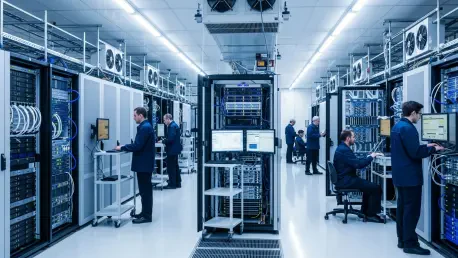

The very element responsible for cooling the world’s most critical digital infrastructures is also one of their most significant existential threats: water. Within the meticulously controlled environments of modern data centers, where even a speck of dust can be a problem, a simple pipe leak can escalate into a multi-million dollar catastrophe, triggering server failures, massive data disruption, and extensive remediation efforts. For years, the industry has relied on reactive measures, essentially setting up digital alarms that signal a flood only after the damage has begun. This after-the-fact approach has proven to be an expensive and high-risk gamble in an industry built on uptime and reliability. As the demand for data processing continues to explode, driven by AI and cloud computing, the need for a more intelligent and preemptive approach to infrastructure management has become not just a competitive advantage but an operational necessity, paving the way for technologies that can see a disaster coming before the first drop of water ever hits the floor.
A Proactive Paradigm Shift in Facility Management
The traditional method for handling water leaks in data centers has long been a source of frustration for facility operators. Existing systems, which typically consist of sensors that trigger an alert upon contact with moisture, function more like a fire alarm than a smoke detector—they confirm a disaster is underway rather than preventing one. By the time an operator is notified, water may have already compromised sensitive electronic equipment, leading to a frantic and costly cleanup process. Responding to this critical gap in the market, a technology startup named MayimFlow has emerged with a fundamentally different philosophy. Founded by John Khazraee, an industry veteran with over 15 years of infrastructure experience at global technology giants like IBM, Oracle, and Microsoft, the company aims to transform leak detection from a reactive chore into a proactive science. The company, which recently gained prominence as a winner at TechCrunch Disrupt, is positioning itself as an essential service provider, offering the critical tools needed to safeguard the massive investments pouring into the data center construction boom.
At the heart of this innovative approach is a sophisticated system that leverages the power of the Internet of Things (IoT) and edge-deployed machine learning. Instead of waiting for a leak to happen, the platform continuously monitors a facility’s complex network of water systems, collecting and analyzing a constant stream of data. These advanced predictive models, trained on vast datasets from various industrial water systems, are capable of identifying the subtle anomalies and microscopic changes in pressure, flow, and temperature that signal an impending pipe failure or equipment malfunction. This allows the system to provide operators with a crucial 24 to 48-hour advanced warning that a specific component requires maintenance. This predictive capability represents a monumental shift, empowering data center managers to schedule repairs during planned downtime, avoid catastrophic failures, and transition from a state of constant emergency response to one of controlled, predictive maintenance. MayimFlow offers a flexible implementation model, either by providing its own proprietary sensors or by integrating its intelligent software with a client’s existing hardware infrastructure.
Beyond the Data Center’s Walls
The vision for this predictive technology is driven by a small but deeply experienced team with a clear mission. Founder John Khazraee’s motivation stems not only from his extensive professional background but also from a personal commitment to efficiency and resourcefulness. To bring his vision to life, he has assembled a team of industry experts, including Chief Strategy Officer Jim Wong, a seasoned veteran of the data center industry, and Chief Technology Officer Ray Lok, a specialist in water management and IoT systems. This combined expertise forms the foundation of the company’s strategy and technological execution. Khazraee’s profound belief in the importance of proactive water management is demonstrated by his decision to forgo opportunities at major tech corporations to focus exclusively on this venture. He recognized that the challenge of preventing water waste and damage extends far beyond data centers, touching on the broader, more urgent global imperative of water conservation and responsible resource management in an increasingly strained world.
The Future of Predictive Water Management
The development of predictive analytics for water systems represented a significant turning point for infrastructure management. While the initial focus was on mitigating the high-stakes risks within data centers, the technology’s potential applications were quickly seen to be far broader. The company’s strategic roadmap included extending its platform to other critical sectors where water leaks pose a significant financial or safety risk, such as commercial high-rises, hospitals, large-scale manufacturing plants, and public utilities. In each of these environments, the ability to preemptively identify and address potential failures offered a clear value proposition: preventing operational disruptions, reducing costly repairs, and conserving a vital natural resource. This shift from reactive alarms to proactive intelligence has redefined the standard of care for complex facilities, proving that the integration of AI and IoT could provide a powerful defense against preventable disasters and usher in a new era of optimized, sustainable water usage.