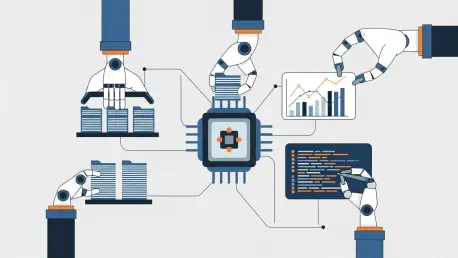

The recent market tremors caused by the introduction of specialized AI agent platforms have unequivocally signaled that enterprise automation is undergoing a fundamental transformation. AI Workflow Agents represent a significant advancement in enterprise automation and artificial intelligence. This review will explore the evolution of this technology, its key architectural components, performance in real-world scenarios, and the impact it is having on various business functions. The purpose of this review is to provide a thorough understanding of the technology, its current capabilities, and its potential future development.
The Dawn of Autonomous Workflows
AI workflow agents represent a leap beyond traditional automation, functioning as autonomous entities capable of interpreting complex goals, formulating multi-step plans, and executing tasks across various digital environments. Their core principles revolve around task decomposition, strategic planning, and dynamic tool execution. Unlike simpler chatbots that operate within a limited conversational scope or scripts that follow rigid, predefined rules, these agents possess a degree of reasoning that allows them to adapt to unforeseen circumstances and make decisions in real time.
This capacity for autonomous action positions AI agents as a cornerstone technology in the broader push toward digital transformation and hyperautomation. They are not merely tools for completing isolated tasks but are increasingly seen as digital team members that can manage entire workflows. Their relevance grows as businesses seek to streamline operations, enhance productivity, and unlock new efficiencies by automating processes that were once too complex or dynamic for conventional software.
Deconstructing the AI Agent Architecture
Core Intelligence: The Role of Large Language Models
At the heart of every AI workflow agent lies a foundational Large Language Model, which serves as its central processing unit for reasoning, language comprehension, and decision-making. The choice of LLM directly dictates the agent’s capabilities; more advanced models enable a deeper understanding of nuanced user requests, sophisticated problem-solving, and more reliable execution of complex instructions. This core intelligence is what allows an agent to move beyond simple command-and-response interactions to engage in goal-oriented dialogue and action.
The performance of an agent is inextricably linked to the strengths and weaknesses of its underlying model. For instance, an agent powered by an LLM optimized for code generation will excel in software development tasks, while one based on a model with a vast repository of general knowledge may be better suited for research and analysis. Consequently, the selection of the LLM is a critical strategic decision that impacts an agent’s overall effectiveness and its suitability for specific enterprise use cases.
Task Decomposition and Planning Engines
The true power of an AI agent is unlocked through its ability to deconstruct a high-level, ambiguous user request into a concrete series of executable steps. This process is managed by a sophisticated planning engine that employs strategies like Chain-of-Thought or ReAct (Reasoning and Acting). These frameworks allow the agent to “think” through a problem, formulate a logical plan, select the appropriate tools for each step, and adjust its strategy based on the outcomes of its actions.
This planning mechanism is what separates a true workflow agent from a simple automation script. Instead of following a predetermined path, the agent dynamically charts its course toward a goal. For example, a request to “analyze recent sales data and identify top-performing regions” would trigger the engine to devise a plan: first, access the sales database; second, execute a query for the relevant data; third, perform statistical analysis; and finally, synthesize the findings into a summary report.
Tool Integration and API Ecosystems
For an AI agent to execute its plans, it must be able to interact with the outside world. This is achieved through robust tool integration and access to a rich ecosystem of Application Programming Interfaces. Agents use APIs to connect with external software, databases, and services, enabling them to perform actions such as sending emails, updating CRM records, managing cloud infrastructure, or querying financial data. The ability to seamlessly leverage these external tools is fundamental to an agent’s utility in a business context.
The expansion of this capability relies on secure and well-documented integration frameworks. Enterprises must establish strict security protocols and access controls to ensure that agents can perform their duties without exposing sensitive data or creating system vulnerabilities. As the technology matures, a growing marketplace of agent-compatible tools and platforms is emerging, simplifying the process of equipping agents with the capabilities they need to handle increasingly complex enterprise workflows.
Memory and Learning Mechanisms
To provide contextually aware assistance and improve over time, AI agents rely on sophisticated memory and learning mechanisms. Short-term memory allows the agent to track the immediate context of a conversation or task, ensuring coherence and relevance in its responses and actions. This working memory is essential for multi-turn interactions where the agent must recall previous steps and user inputs to proceed effectively.
Long-term memory, in contrast, enables the agent to learn from past experiences, user feedback, and the outcomes of completed tasks. By storing and retrieving information about successful and unsuccessful workflows, the agent can continuously refine its strategies and improve its performance. This learning loop is critical for moving beyond static automation to create a system that becomes more efficient and reliable with each interaction, adapting to the specific needs and processes of an organization.
Current Landscape and Emerging Trends
The field of AI workflow agents is evolving at a rapid pace, with major technology companies and agile startups alike introducing specialized agent platforms. This competitive landscape is fueling innovation and driving the development of more powerful and accessible agentic systems. One of the most significant trends is the rise of multi-agent collaboration, where multiple specialized agents work together to solve complex problems that are beyond the scope of a single agent.
Simultaneously, there is a distinct shift toward no-code and low-code agent creation interfaces. These platforms are democratizing access to the technology, allowing business users without technical expertise to design, build, and deploy their own AI agents to automate their specific workflows. This is accompanied by a growing focus on vertical-specific agents tailored for industries like finance, healthcare, and legal services, which are equipped with domain-specific knowledge and tools to address unique industry challenges.
Real-World Applications and Industry Impact
Revolutionizing Software Development and DevOps
In the software development lifecycle, AI agents are becoming indispensable partners for engineering teams. They are being deployed to automate a wide range of tasks, from writing boilerplate code and generating unit tests to debugging complex applications and identifying performance bottlenecks. By offloading these time-consuming activities, agents free up developers to focus on higher-level architectural design and feature innovation.
Within DevOps, these agents are streamlining operations by managing cloud infrastructure deployments, automating continuous integration and continuous delivery pipelines, and monitoring system health. For example, an agent can be tasked with automatically scaling server resources in response to traffic spikes or rolling back a failed deployment. These applications lead to a significant increase in developer productivity, a reduction in human error, and a faster time-to-market for new software products.
Streamlining Business Operations and Analytics
AI agents are transforming back-office functions by automating tedious and repetitive processes that have historically required significant manual effort. This includes tasks such as data entry from unstructured documents, generating routine financial reports, and reconciling accounts payable and receivable. By handling these workflows, agents not only improve operational efficiency but also enhance data accuracy and ensure compliance with business rules.
Beyond simple task automation, agents are also being applied to complex data analysis and business intelligence. They can be instructed to conduct market research by scraping and synthesizing information from various online sources, analyze large datasets to identify emerging trends, and generate insightful reports for executive decision-making. This empowers organizations to derive actionable intelligence from their data more quickly and effectively than ever before.
Enhancing Customer Support and Service Desks
The impact of AI agents is profoundly felt in customer support and IT service desks, where they are elevating the quality and efficiency of service delivery. Agents are capable of handling complex customer inquiries that go far beyond the scope of traditional chatbots, accessing knowledge bases and customer history to provide personalized and accurate resolutions. They can manage the entire lifecycle of a support ticket, from initial creation and triage to final resolution and closure.
Furthermore, agents are being used to proactively identify and solve IT issues before they impact end-users. By monitoring system logs and performance metrics, an agent can detect anomalies, diagnose the root cause of a problem, and execute corrective actions, such as restarting a service or applying a patch. This proactive approach minimizes downtime and improves the overall user experience, transforming service desks from reactive fire-fighting units into proactive operational partners.
Navigating the Challenges and Limitations
Reliability and the Predictability Problem
Despite their advancing capabilities, AI workflow agents still grapple with significant challenges related to reliability and predictability. The phenomenon of “hallucination,” where an LLM generates factually incorrect or nonsensical information, remains a persistent issue. This can lead to agents making flawed decisions or executing incorrect actions. Ensuring that an agent follows instructions with precision and performs consistently across repeated tasks is a major technical hurdle, particularly in high-stakes environments where errors can have severe consequences.
The inherent non-deterministic nature of some LLMs means that an agent might produce slightly different outputs or follow different paths even when given the same initial prompt. This lack of predictability makes it difficult to validate agent behavior and guarantee safe operation. Overcoming these issues requires advances in model alignment, improved reasoning frameworks, and robust testing methodologies to build trust and ensure dependable performance in mission-critical applications.
Security, Privacy, and Data Governance
Granting autonomous agents access to sensitive corporate data, internal systems, and third-party APIs introduces significant security and privacy risks. An improperly configured or compromised agent could potentially leak confidential information, execute unauthorized transactions, or create vulnerabilities in the IT infrastructure. Establishing a robust security posture is therefore paramount for any organization looking to deploy AI agents at scale.
This requires the development of comprehensive data governance frameworks that clearly define what data an agent can access, what actions it is permitted to take, and how its activities are logged and audited. Implementing granular access controls, encrypting data both in transit and at rest, and conducting regular security audits are critical steps. Without clear governance and stringent security measures, the potential for data breaches and misuse of an agent’s capabilities poses a substantial barrier to adoption.
Integration Complexity and Scalability Hurdles
One of the most significant practical challenges in deploying AI workflow agents is integrating them with an organization’s existing, often legacy, enterprise systems. Many older systems lack modern APIs, making it difficult and time-consuming to connect agents to the data and tools they need to function effectively. This integration complexity can slow down implementation projects and increase the total cost of ownership.
Furthermore, managing the performance and computational costs of agents at scale presents another major hurdle. The LLMs that power these agents are resource-intensive, and running a large number of agents concurrently can lead to substantial infrastructure costs and potential performance bottlenecks. Organizations must carefully plan their architecture to ensure it can support the demands of a growing agent workforce while managing costs and maintaining responsiveness.
The Future Trajectory of Workflow Automation
The trajectory of AI workflow agents points toward a future of increasingly autonomous systems capable of managing entire business functions with minimal human oversight. Forthcoming breakthroughs in agentic reasoning, long-term planning, and self-correction will likely enable agents to tackle problems of unprecedented complexity. This evolution will move them from being tools that assist humans to partners that can independently own and execute strategic initiatives from start to finish.
In the coming years, the convergence of AI agents with physical robotics is also expected to unlock new possibilities, extending workflow automation from the digital realm into the physical world. This could lead to fully automated supply chains, smart factories, and autonomous service delivery in various industries. The long-term impact of this technological shift on the future of work and organizational structures will be profound, necessitating a rethinking of roles, responsibilities, and the very nature of human-computer collaboration.
Conclusion: A Paradigm Shift in Productivity
The rise of AI workflow agents marked a pivotal moment in the evolution of enterprise automation, signaling a definitive shift from task-based scripts to goal-oriented autonomous systems. Their architecture, built upon powerful large language models, sophisticated planning engines, and extensive tool integration, provided a new framework for tackling complex business processes. The real-world applications across software development, business operations, and customer service demonstrated their tangible impact on productivity and efficiency.
However, the journey was not without its obstacles. Significant challenges related to reliability, security, and integration complexity highlighted the technical and organizational hurdles that needed to be overcome for widespread, successful adoption. Ultimately, the review of AI workflow agents revealed a technology with transformative potential. It presented a paradigm shift in how work is done, but its successful implementation depended on a balanced approach that embraced its innovative power while diligently managing its inherent risks.